ChallengeEU Strategy Board defines next steps in Valencia
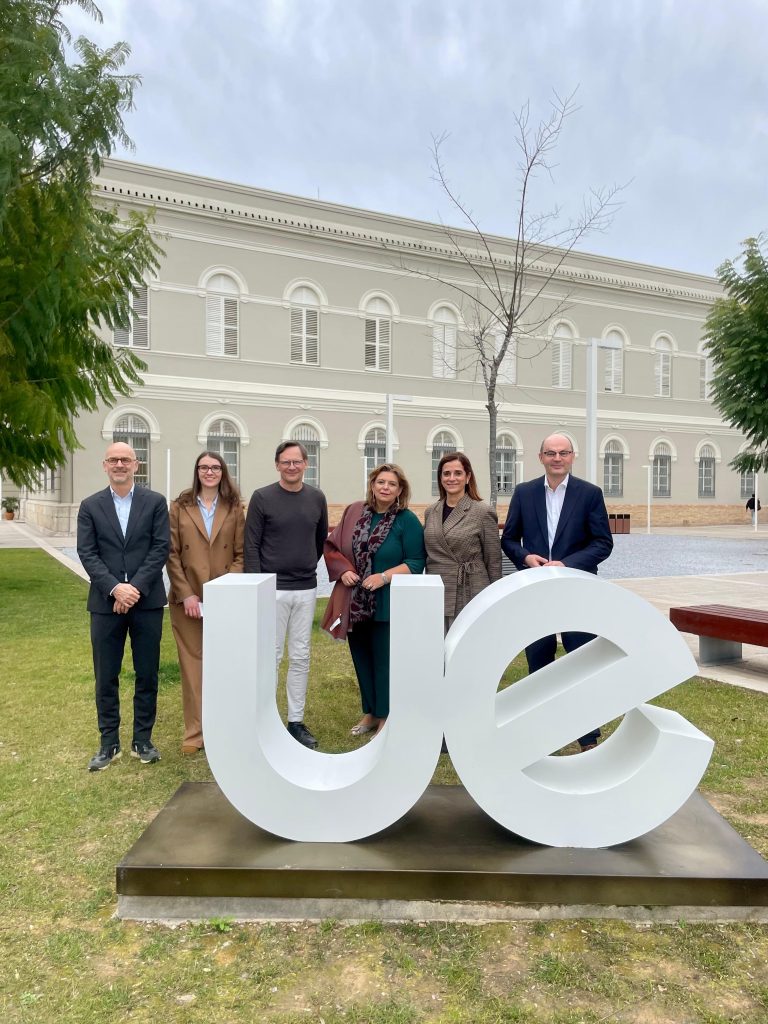
The Strategy Board, made up of the Rectors of the nine member universities, holds its meeting at the Turia Campus to take stock of the alliance’s first year and define future directions. On Tuesday (10 February), Universidad Europea de Valencia hosted the meeting of the ChallengeEU Strategy Board. This meeting brought together, at the Turia Campus, the rectors of the nine universities that make up the Alliance in a working session focused on future directions, strategic challenges and the evolution of the project. The day began with a welcome coffee, during which Dr Esther Gómez, Regional Secretary for Universities of the Generalitat Valenciana, gave a few words of institutional greeting to the Rectors of the alliance before starting the programme of activities. During the working session, the Strategy Board addressed the presentation of the results of the alliance’s first year of operation, as well as the analysis of the medium and long-term strategy, focused on consolidating the vision and priorities for the coming years. The meeting also allowed progress to be made on the proposal to create double degrees between member universities, as well as exploring the possible incorporation of a Ukrainian polytechnic university as an associate member, in line with ChallengeEU’s commitment to broader and more diverse European cooperation. The meeting was chaired by Prof. Tobias Hagen, Director General of ChallengeEU, and by the Secretary General, Sofiia Hecker, both from the University of Offenburg (Germany), the institution responsible for the overall coordination of the alliance. Dr Annette Klinkert, director of the technical agency that has accompanied ChallengeEU in its application and development process, also participated in the proceedings. The session also agreed that the Rector of the Universidade Europeia de Lisboa, Prof. Helia Gonçalves, will assume the chairmanship of the Strategy Board during the alliance’s second year of operation, replacing Prof. Stephan Trahasch, Rector of the Offenburg University of Applied Sciences (Germany). Likewise, the Rector of Mid Sweden University (Sweden), Docent Anders Fallström, has been appointed as the new Vice-President of the body. Two Student Council representatives at the Strategy Board – Hannah Rendle from Hochschule Offenburg and Keshini Nistar from ECAM LaSalle – held their final meeting in this role. Throughout their mandate, they actively contributed student perspectives to the Alliance’s highest decision-making body, ensuring that the student voice remained an integral part of strategic discussions. New Student Council representatives will soon be elected to continue representing students at the Strategy Board.
The ChallengeEU Mentoring Programme has officially launched
On Monday, January 19, and Thursday, January 22, meetings officially inaugurating the ChallengeEU Mentoring Programme took place. The programme is coordinated by the University of Warmia and Mazury. The ChallengeEU Mentoring Programme aims to provide students with support from European professionals, boost their self-confidence and skills, and help them define their career paths – all through mentoring rooted in the idea of ODEI (Openness, Diversity, Equity and Inclusion). During the first kick-off meeting, participants were welcomed by Prof. Paweł Wielgosz, Rector’s Representative for European Universities, while the second meeting was opened by Prof. Tobias Hagen, Vice-Rector for Internationalisation at Hochschule Offenburg and Chair of the ChallengeEU Alliance. Both speakers spoke about the ChallengeEU Alliance and the role the mentoring programme plays within it. They also expressed their thanks to everyone involved in the programme and to those who showed interest in participating Starting together The main idea behind the kick-off meetings was to allow all mentors and mentees to inaugurate the programme together and to ensure they knew what to expect in the subsequent stages. “The mentoring programme is of great importance to the ChallengeEU Alliance, as it represents a direct investment in what is most valuable – people. It demonstrates that UWM, as the programme organiser and a member of the alliance, is committed to implementing the principles of ODEI. This is crucial for building a culture of openness and development,” said Prof. Katarzyna Ćwirynkało from the Faculty of Social Sciences and ODEI Officer in the ChallengeEU Alliance. The ChallengeEU Mentoring Programme is addressed to all students at universities participating in the alliance. Mentors may include academic staff as well as professionals from outside the academic community, including entrepreneurs. In total, 75 mentors and 79 mentees applied. During the meetings, participants became familiar with essential information about how the programme works, what it involves, and what will take place in the coming weeks. They also had the opportunity to meet the team from the University of Warmia and Mazury responsible for organising the initiative. The team includes Prof. Katarzyna Ćwirynkało, Dr Monika Ryndzionek and Agata Przyborowska, MA, supported by members of Work Package 5. The first edition of the mentoring programme within the ChallengeEU Alliance will last approximately six months. A minimum of five mentor–mentee meetings is planned, which will primarily take place online (with the option of meeting on university campuses). Both mentors and mentees will receive certificates of participation upon completion of the programme. A dose of essential knowledge After both inauguration meetings, training sessions for mentors were held and led by Dr Monika Ryndzionek. During these sessions, mentors learned about their roles, received practical tools and tips to help them fulfil their responsibilities, and became thoroughly familiar with the goals of the ChallengeEU Alliance mentoring programme. Each training session lasted 75 minutes. “The idea behind mentoring programmes is to learn from more experienced people in various areas and fields of life, as mentors may include university staff, representatives of non-governmental organisations, or entrepreneurs. However, it is worth remembering that mentors also develop through this process, for example by sharing their experience,” emphasised Dr Monika Ryndzionek from the Faculty of Social Sciences, an ODEI expert in the ChallengeEU Alliance. Photo by: Freepik.com
AI in higher education discussed at the Online Café meeting

On December 18, ChallengeEU organized its first Online Café on Artificial Intelligence, bringing together professors from across the Alliance to share institutional practices, ethical guidelines, and innovative solutions for AI integration in higher education. ChallengeEU Online Café was dedicated to one of the most transformative topics in academia today: Artificial Intelligence in higher education. The aim of the meeting was to create a collegial and open space for discussion, where professors and academic staff could meet peers facing similar questions, exchange experiences, and gather ideas for their own pedagogical practice. The conversation was broadly structured around three overarching questions: how are institutions framing and supervising students’ use of AI?; in what ways can AI enrich teaching and course activities?; what governance, support mechanisms, and ethical frameworks are needed for responsible AI use? This session brought together four speakers from four ChallengeEU partner universities, each offering brief insights into AI-related initiatives developed at their institutions. Sara Gancho from Universidade Europeia de Lisoboa showcased institutional initiatives: AI Best Practices Awards, professor training and ethical guidelines. Florije Ismaili from Southeast European University presented AI@SEU, a system with three modules to streamline admissions, academic guidance, and research support. Ingus Šmits from Latvia University of Life Sciences and Technologies addressed challenges of generative AI in student work and lecturer training to ensure integrity. Etienne Bossy from ECAM LaSalle shared experience with AI detection tools and mandatory AI usage forms, aiming to balance transparency, ethics, and practical assessment in engineering education. These presentations were followed by breakout room sessions, which allowed professors to interact more deeply on this topic. In the future, further events from the Online Café series will take place. Photo: www.freepik.com
Holiday Traditions Across the ChallengeEU Alliance

The ChallengeEU Alliance brings together nine universities from nine different countries. Members of our community are happy to share their cultures with one another – including the traditions that shape them. We invite you to explore a short guide to customs associated with the Christmas and New Year holiday season. From candlelit processions and Christmas markets to family feasts, carols, and small acts of kindness, the weeks around the end of the year look a little different in every country – yet they share a common spirit of togetherness. Below, our partner universities take you on a festive journey through their local traditions, favourite flavours, and the unique ways their campuses celebrate the season. Latvia: Candlelit Ziemassvētki, Nine Dishes and the Magic of Riga’s Christmas Market Christmas in Latvia is a blend of Christian tradition and deep-rooted pagan customs that honour light, nature, and renewal. The season begins with Advent, when homes glow with candles and the aroma of piparkūkas – spiced gingerbread – fills the air. On December 24th, Ziemassvētki, families gather for a warm and peaceful celebration. Many still observe the old custom of eating nine symbolic dishes, believed to bring strength and luck, e.g. grey peas with bacon for prosperity. The Christmas tree also has special significance here: Latvia is one of the first places in Europe where the decorated tree tradition was recorded, dating back to the 16th century. Instead of folk songs and ķekatas, many visitors today experience the festive atmosphere at the Riga Christmas Market, one of the most charming and celebrated markets in the world. Set in the heart of the Old Town, it glows with wooden stalls, handmade crafts, mulled wine, local delicacies, and traditional music. Tourists and locals gather around the towering Christmas tree in Doma Square, creating a warm, bustling contrast to the crisp winter air. Christmas in Latvia remains slow, candlelit, and deeply rooted in tradition – yet beautifully complemented by the magical charm of Riga’s world-famous market. Latvia University of Life Sciences and Technologies has its own special Christmas traditions. One of the most elegant and anticipated events in the country is the Christmas Ball held in Jelgava Palace, bringing together students, staff, and guests for an evening of music, dancing, and rich historical atmosphere. Each year, LBTU also hosts a Christmas market organized by students and university employees, offering handmade gifts, festive treats, and a warm sense of community. Another cherished tradition is the LBTU Winter Solstice greeting, which highlights the university’s connection to Latvian seasonal heritage. Among the most significant traditions is the formal session of the LBTU Convent, a ceremonial gathering that reflects the university’s academic spirit and long–standing cultural identity. Spain: Twelve Grapes, the Christmas Lottery and Three Kings In Spain, Christmas celebrations are deeply rooted in tradition. Families and close friends gather on Christmas Eve and Christmas Day to share festive meals and joyful moments. New Year’s Eve is equally special: people flock to the main square of their city or village, holding twelve grapes to eat in rhythm with the twelve chimes of midnight. Finishing all twelve grapes before the last chime is believed to bring good luck in the year ahead. Another highlight of the season occurs on December 22, when the entire country tunes in to watch the National Christmas Lottery. Known as the largest lottery in the world, it boasts a prize pool of €2.7 billion, with more than 70% of Spaniards participating. Finally, on January 6, Spain celebrates the arrival of the Three Wise Kings. Traditionally, Spanish children receive their gifts from the Reyes Magos rather than from Father Christmas. During the holidays, Christmas music echoes everywhere. Alongside global favorites like All I Want for Christmas Is You, traditional Spanish carols can be heard in Christmas markets, bustling streets, and department stores, adding a uniquely local charm to the festivities. Christmas in Spain is also a feast for the senses. Families enjoy dishes such as turkey, seafood, and comforting meatball soup, accompanied by classic sweets like nougat and polvorones. On January 6, the celebration continues with the Roscón de Reyes, a special cake hiding a bean inside. Whoever finds it is crowned “King” for the day, adding a playful tradition to the holiday table. At Universidad Europea de Valencia, the festive spirit fills every corner. Buildings are beautifully decorated with Christmas ornaments and a grand tree, creating a warm and joyful atmosphere. The university also partners with Fundación Mi Aportación to fulfill the wishes of underprivileged individuals who have written heartfelt letters. In addition, student clubs – ranging from sports to cultural groups – organize special activities to celebrate the season together. North Macedonia: Holiday Songs, Flavours, Buzmi and Badnik Traditions In North Macedonia, winter holidays are celebrated across communities through a mix of shared practices and distinct cultural traditions shaped by the country’s multiconfessional character. New Year’s Eve (31 December) is widely observed as a family celebration, marked by festive meals, visits, and gifts for children. Among Albanians, the holiday season carries an additional cultural layer rooted in the ancient traditions of Buzmi and Kërshëndellat – pre-Christian solstice rituals symbolizing renewal and the rebirth of light. The burning of the buzmi log expresses hopes for prosperity and good fortune, while Kërshëndellat are understood as të këndellunit e ditës së re – the awakening of the new day. Macedonian families observe Badnik on 6 January and Orthodox Christmas on 7 January. Across the country, all communities welcome the season with warm hospitality, family gatherings, and traditions that blend spiritual meaning with elements of older symbolism. Most families decorate Christmas trees as part of the New Year festivities. End-of-year celebrations also fill schools with laughter and excitement, as children present songs, dramas, and poems during festive concerts. During the winter holidays in North Macedonia, music reflects the country’s cultural diversity. Among Albanians, children often sing “Drenushat vrapojnë” (“The Does Are Running”), a playful winter song – similar in melody to Jingle Bells – that is especially popular around New Year.
UWM–HSO meeting: Cooperation is a shield in difficult times
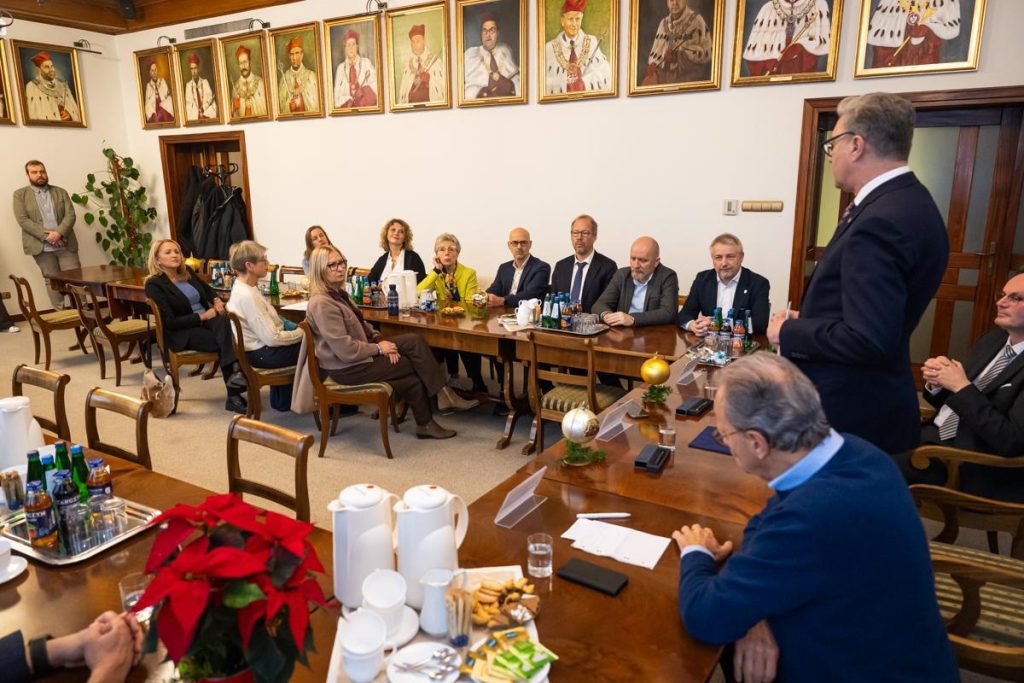
On Monday, 8 December, the University of Warmia and Mazury was visited by guests from Hochschule Offenburg and the Maria and Georg Dietrich Foundation. The pre-Christmas meeting is a tradition that strengthens the ties between the two partner universities. It was, among other things, this friendship that gave rise to the ChallengeEU Alliance. The annual UWM–HSO meeting is a tradition. Professor Jerzy Przyborowski, Rector of the University of Warmia and Mazury (UWM), welcomed the delegation in the rector’s office building, saying: “I am very grateful that we can meet every year as part of the Christmas Bridge initiative, launched by Georg Dietrich. It is a true symbol of friendship between our institutions, but also between all the people involved.” Both the host and the guests emphasised that good relations between countries are more important than ever in the face of the ongoing war in Ukraine and many other geopolitical threats. “Thank you very much for this wonderful welcome during Advent. For us, this is not an official visit – it is a visit to friends. This friendship is a prerequisite for successful cooperation, because something good usually grows out of human relationships,” said Prof. Dr Stephan Trahasch, Rector of Hochschule Offenburg (HSO). Participants in the meeting underlined that what has particularly strengthened the friendship between the University of Warmia and Mazury and Hochschule Offenburg in recent times is the fact that both universities are members of the ChallengeEU European Universities Alliance. The ChallengeEU Alliance places strong emphasis on student mobility. “Exchange and cooperation among young people form the foundation of unity between nations, and thus of peace in Europe,” explained Stephan Trahasch. During the meeting, discussions on joint initiatives within the ChallengeEU Alliance were continued. Prof. Dr Tobias Hagen, Vice-Rector for Internationalisation at Hochschule Offenburg and Chair of the ChallengeEU Alliance, spoke, among others, with Professor Paweł Wielgosz, the UWM Rector’s Representative for European Universities, about new joint educational programmes and academic cooperation – especially in the field of research. “The project has only just started, but we already have our first results – our academic staff have taken part in joint training sessions, and in recent days students, including from our university, met in Offenburg,” said Prof. Paweł Wielgosz. “We are preparing to launch new joint study programmes – not only with HSO, but also with other partner universities. It is also very important to me that we can conduct scientific research together. From experience, I know that effective academic cooperation is often born precisely from joint research. I hope that our working meetings will lead to ideas for new study programmes and new areas of scientific collaboration.” As Prof. Dr Stephan Trahasch recalled, in addition to cooperation within the ChallengeEU Alliance and its other dimensions, what connects UWM and HSO is joint education. The universities run two programmes at the Faculty of Geoengineering (Environmental Engineering in the field of Process Engineering and Biotechnology) and one at the Faculty of Food Science (Food Technology and Human Nutrition in the field of Food Engineering). They also cooperate in programmes such as German Studies and Business Linguistics, in which students also learn German. Prof. Dr Tobias Hagen, who took part in several ChallengeEU working meetings during his stay at UWM (including one devoted to the conference planned for May to summarise the Alliance’s first year of activities), noted that discussions within the ChallengeEU team and with the Faculties of Economics, Geoengineering and Food Science were intensive, extremely fruitful and constructive, and took place in a very friendly atmosphere. He was convinced that this would enable us to further develop the long-standing partnership between our universities and that there would be many new ideas for the future. The HSO delegation also included Prof. Dr Jens Pfafferott (Dean of the Faculty of Mechanical Engineering and Process Engineering in Offenburg), who had the opportunity to meet with UWM representatives to discuss possibilities for further cooperation. Dr Wolfgang Bruder, Chairman of the Georg and Maria Dietrich Foundation, noted that over the years the foundation has awarded more than 200 scholarships to UWM students, contributing to broadening knowledge, creating better learning conditions, and deepening cooperation. In this way, it continues the ideas of Georg Dietrich, who already decades ago deeply understood the importance of Polish–German cooperation and was committed to ensuring that it also developed at university level.