UWM–HSO meeting: Cooperation is a shield in difficult times

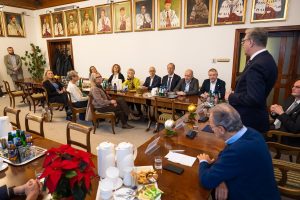
On Monday, 8 December, the University of Warmia and Mazury was visited by guests from Hochschule Offenburg and the Maria and Georg Dietrich Foundation. The pre-Christmas meeting is a tradition that strengthens the ties between the two partner universities. It was, among other things, this friendship that gave rise to the ChallengeEU Alliance. The annual UWM–HSO meeting is a tradition. Professor Jerzy Przyborowski, Rector of the University of Warmia and Mazury (UWM), welcomed the delegation in the rector’s office building, saying: “I am very grateful that we can meet every year as part of the Christmas Bridge initiative, launched by Georg Dietrich. It is a true symbol of friendship between our institutions, but also between all the people involved.” Both the host and the guests emphasised that good relations between countries are more important than ever in the face of the ongoing war in Ukraine and many other geopolitical threats. “Thank you very much for this wonderful welcome during Advent. For us, this is not an official visit – it is a visit to friends. This friendship is a prerequisite for successful cooperation, because something good usually grows out of human relationships,” said Prof. Dr Stephan Trahasch, Rector of Hochschule Offenburg (HSO). Participants in the meeting underlined that what has particularly strengthened the friendship between the University of Warmia and Mazury and Hochschule Offenburg in recent times is the fact that both universities are members of the ChallengeEU European Universities Alliance. The ChallengeEU Alliance places strong emphasis on student mobility. “Exchange and cooperation among young people form the foundation of unity between nations, and thus of peace in Europe,” explained Stephan Trahasch. During the meeting, discussions on joint initiatives within the ChallengeEU Alliance were continued. Prof. Dr Tobias Hagen, Vice-Rector for Internationalisation at Hochschule Offenburg and Chair of the ChallengeEU Alliance, spoke, among others, with Professor Paweł Wielgosz, the UWM Rector’s Representative for European Universities, about new joint educational programmes and academic cooperation – especially in the field of research. “The project has only just started, but we already have our first results – our academic staff have taken part in joint training sessions, and in recent days students, including from our university, met in Offenburg,” said Prof. Paweł Wielgosz. “We are preparing to launch new joint study programmes – not only with HSO, but also with other partner universities. It is also very important to me that we can conduct scientific research together. From experience, I know that effective academic cooperation is often born precisely from joint research. I hope that our working meetings will lead to ideas for new study programmes and new areas of scientific collaboration.” As Prof. Dr Stephan Trahasch recalled, in addition to cooperation within the ChallengeEU Alliance and its other dimensions, what connects UWM and HSO is joint education. The universities run two programmes at the Faculty of Geoengineering (Environmental Engineering in the field of Process Engineering and Biotechnology) and one at the Faculty of Food Science (Food Technology and Human Nutrition in the field of Food Engineering). They also cooperate in programmes such as German Studies and Business Linguistics, in which students also learn German. Prof. Dr Tobias Hagen, who took part in several ChallengeEU working meetings during his stay at UWM (including one devoted to the conference planned for May to summarise the Alliance’s first year of activities), noted that discussions within the ChallengeEU team and with the Faculties of Economics, Geoengineering and Food Science were intensive, extremely fruitful and constructive, and took place in a very friendly atmosphere. He was convinced that this would enable us to further develop the long-standing partnership between our universities and that there would be many new ideas for the future. The HSO delegation also included Prof. Dr Jens Pfafferott (Dean of the Faculty of Mechanical Engineering and Process Engineering in Offenburg), who had the opportunity to meet with UWM representatives to discuss possibilities for further cooperation. Dr Wolfgang Bruder, Chairman of the Georg and Maria Dietrich Foundation, noted that over the years the foundation has awarded more than 200 scholarships to UWM students, contributing to broadening knowledge, creating better learning conditions, and deepening cooperation. In this way, it continues the ideas of Georg Dietrich, who already decades ago deeply understood the importance of Polish–German cooperation and was committed to ensuring that it also developed at university level.
ChallengeEU Collaboration Powered by Lab IDEAS BIP

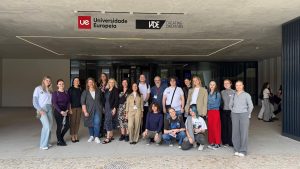
The ChallengeEU Alliance continues to promote collaboration and innovation through the Lab IDEAS: Impact-Driven Education for Action and Sustainability Blended Intensive Program (BIP), organized by IADE – Faculty of Design, Technology and Communication of Universidade Europeia, one of the founding institutions of the alliance in Lisbon, Portugal. The programme, held under Erasmus+, gathered 51 participants, including 36 international travelling participants from partner universities. Among them were students and professors from two ChallengeEU institutions, Latvia University of Life Sciences and Technologies and the University of Warmia and Mazury in Olsztyn, who joined multidisciplinary teams to co-create innovative solutions addressing digital behaviour and social responsibility. Under the theme “Designing Safe Digital Communities”, and in collaboration with the Portuguese Public Security Police (PSP), participants explored how social design can help prevent cyberbullying, foster empathy, and promote safer and more inclusive online environments. Students proposed a range of solutions, including ideas for board games for children and teenagers, creating a website to support victims, and developing informational materials for professionals involved in bullying prevention in cooperation with the police. They also drafted the idea of establishing an association that could later evolve into a social movement. As explained, this could help raise awareness of bullying in society and schools and contribute to creating a safe environment where victims can receive practical and psychological support. All of these solutions were presented to representatives of the police in Lisbon. “The concept of this programme really appeals to me. It was four days of intensive work with a tangible outcome at the end (presented to the client) — that’s exactly what we, students of Trend Analysis and Creation, enjoy. I’m very glad we have the opportunity to take part in initiatives like this. I’d happily do it again,” says Dominika Staniszewska, a student of Trend Analysis and Creation at University of Warmia and Mazury. Wiktor Kotarski, who also studies at UWM, adds:“I think the idea is excellent because it lets us look at what we’ll be doing professionally from a completely different perspective. Another advantage is that it allows you to test yourself in a new, international environment. In my view, the intensity is a plus – in a short time you can see whether this kind of work is for you. And if you decide it isn’t, you haven’t lost much time.” “Because we worked in mixed groups, we were able to experience intercultural exchange. Every student brought something new to the project — for example, a different way of thinking or acting. My colleague and I encouraged our teammates to use design-thinking methods, which is how we work at UWM. We exchanged knowledge, which was both pleasant and instructive,” says Dominika. The meeting in Lisbon was a valuable experience not only for the students but also for their accompanying supervisors. For example, Prof. Līga Paula (LBTU) noted that taking part in the mobility programme was an excellent opportunity to gain experience in organising BIPs, establish new contacts, and exchange insights with international colleagues. Through this initiative, the ChallengeEU Alliance reinforces its commitment to interdisciplinary learning, mobility, and social impact, empowering students and educators to transform real-world challenges into opportunities for positive change.
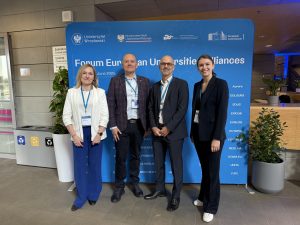
ChallengeEU at the European University Alliances Forum in Wrocław

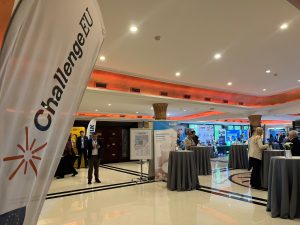
Representatives of the ChallengeEU Alliance are taking part in the 3rd European University Alliances Forum, held in Wrocław, Poland. The event is organized under the Polish Presidency of the Council of the European Union and serves as an important platform for exchange, dialogue, and knowledge sharing among university alliances and key stakeholders. Our delegation (Prof. Dr. Tobias Hagen, HSO’s Vice-Rector for Internationalization and Managing Director of ChallengeEU, Prof. Dr. Paweł Wielgosz, Vice-Deputy Director of ChallengeEU and Rector’s UWM representative for EUI, Sofiia Hecker, Secretary General and Agata Głowacka-Gil, Project Office Coordinator) will gain valuable insights and inspiration through meetings with representatives from other alliances across Europe. The Forum opened with welcome speeches by: Already during the first panel, it was emphasized that European University Alliances are at the very top of the European political agenda Key topics of the Forum included: Participation in the Forum marks another important step in strengthening ChallengeEU’s position within the European academic landscape – and a new opportunity to shape the future of higher education in Europe. >>> 3rd European University Alliances Forum: Summary
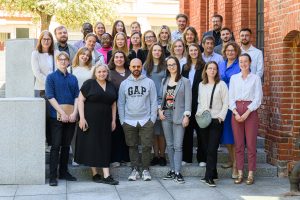
Branding, or building identity. Workshops in Poland

Representatives of the nine universities forming the ChallengeEU alliancemet at the University of Warmia and Mazury in Olsztyn (Poland) to discuss how to communicate and disseminate the alliance’s activities, which aim to open new opportunities for members of the academic community. To discuss the image of the ChallengeEU alliance and strategies for reaching various target audiences, representatives from all partner universities gathered in Olsztyn. Among them, the largest group consisted of those responsible for communication within the project. Also present were leaders of other work packages and the Secretary General of the alliance. All had the opportunity to connect with UWM staff involved in other parts of the project. The workshops were also attended by Prof. Paweł Wielgosz, UWM’s Representative for European Universities. Branding – Building the Identity of the Alliance The identity and future of ChallengeEU will be shaped by those who co-create it and seize the opportunities it offers. However, its image—especially in the eyes of individuals or companies potentially interested in collaborating with the universities—will also play a vital role and should be considered from the very beginning. Working on the alliance’s identity means also working on its visual communication and messaging—key elements that ChallengeEU will use to connect with others. Learning from One Another and Combining Our Strengths The second day was equally productive, featuring workshops and a working meeting held at the UWM Center for Marketing and Media. “A very important part of the visit was the opportunity for our guests to explore various units of UWM — including the editorial offices of the university media, the Office for International Cooperation, the Student Affairs Office, the Center for Cooperation with the Socio-Economic Environment, as well as selected faculties,” explains Dr. Marta Śliwa. “It was a great opportunity to present UWM’s educational offer and scientific potential, but also for our community to learn more about the ideas and objectives of the ChallengeEU alliance.” – “The meeting in Olsztyn was very highly rated by all participants, which is a great joy for us. We feel that thanks to this event, ChallengeEU has truly found its place within our university’s academic space.” Participants of the workshops in Kortowo also emphasized how meeting in person made them realize how strong their relationships have already become — and how positively this strengthens their collaboration. Together with all those involved in the project, they are gradually building the foundation for a shared, open, and inclusive campus.
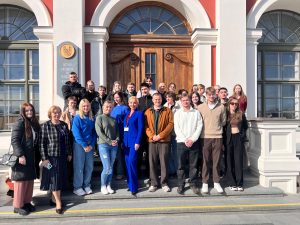
LBTU hosts programme “Media Literacy for Future Leaders”

The Institute of Social and Humanitarian Sciences of the Faculty of Economics and Social Development (ESAF) at the Latvia University of Life Sciences and Technologies (LBTU) has successfully completed the Erasmus+ Blended Intensive Programme (BIP) project “Media Literacy for Future Leaders”. Among the participants were students and lecturers from ChallengeEU partner universities — Hochschule Offenburg, University of Warmia and Mazury in Olsztyn, and South East European University (SEEU) — joined by representatives of the Estonian University of Life Sciences. The program was led by an international team of lecturers, including five LBTU faculty members from ESAF and guest lecturers – professor Edlira Palloshi Disha from North Macedonia, media science professor Urszula Doliwa, and associate professor Magdalena Szydłowska from Poland. The programme focused on media literacy, critical thinking, and intercultural communication — equipping students with tools to analyze digital content, detect disinformation, and craft meaningful messages. Following an initial online seminar, participants gathered for a vibrant study week in Jelgava, featuring hands-on workshops, cultural visits to Riga and Rundāle Palace, and student presentations during the international conference “Students on Their Way to Science”. It was a great experience, as reflected in the words of one of the participants: “I would like to sincerely thank you for the wonderful experience during the Blended Intensive Programme in Latvia. It was an incredibly enriching opportunity, both academically and personally. I am truly grateful for the chance to participate, to meet inspiring peers, and to learn from outstanding professors. The organization and hospitality throughout the programme were exceptional. I truly appreciate all the efforts that made this an unforgettable experience”. >>> More information
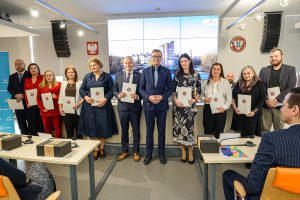
UWM Celebrated Joining the ChallengeEU Alliance

The University of Warmia and Mazury in Olsztyn (UWM) has officially joined the ChallengeEU alliance, marking a significant step in its international development. The official celebration took place on Wednesday, 5 March 2025, at the university’s main campus in Olsztyn. During the event, Prof. Jerzy Przyborowski, Rector of UWM, formally presented appointment certificates to the university team members engaged in the project. As he emphasized, participation in the ChallengeEU alliance represents a strategic opportunity not only for the university itself but also for the broader development of the region. The meeting served as an occasion to introduce the vision and objectives of ChallengeEU to the university community and regional stakeholders. Prof. Paweł Wielgosz, UWM’s Coordinator for European Universities, highlighted the several years of intensive preparations that led to the university’s inclusion in the alliance. He also underlined the significance of this achievement, noting that currently, fewer than 10 percent of higher education institutions in Europe are members of university alliances under the European Universities initiative. The event brought together representatives from local government, business sectors, and non-governmental organisations, who expressed their enthusiasm and support for this international academic collaboration. Joining ChallengeEU opens new paths for innovation, mobility, and excellence in education — and UWM is proud to be part of this shared European vision.