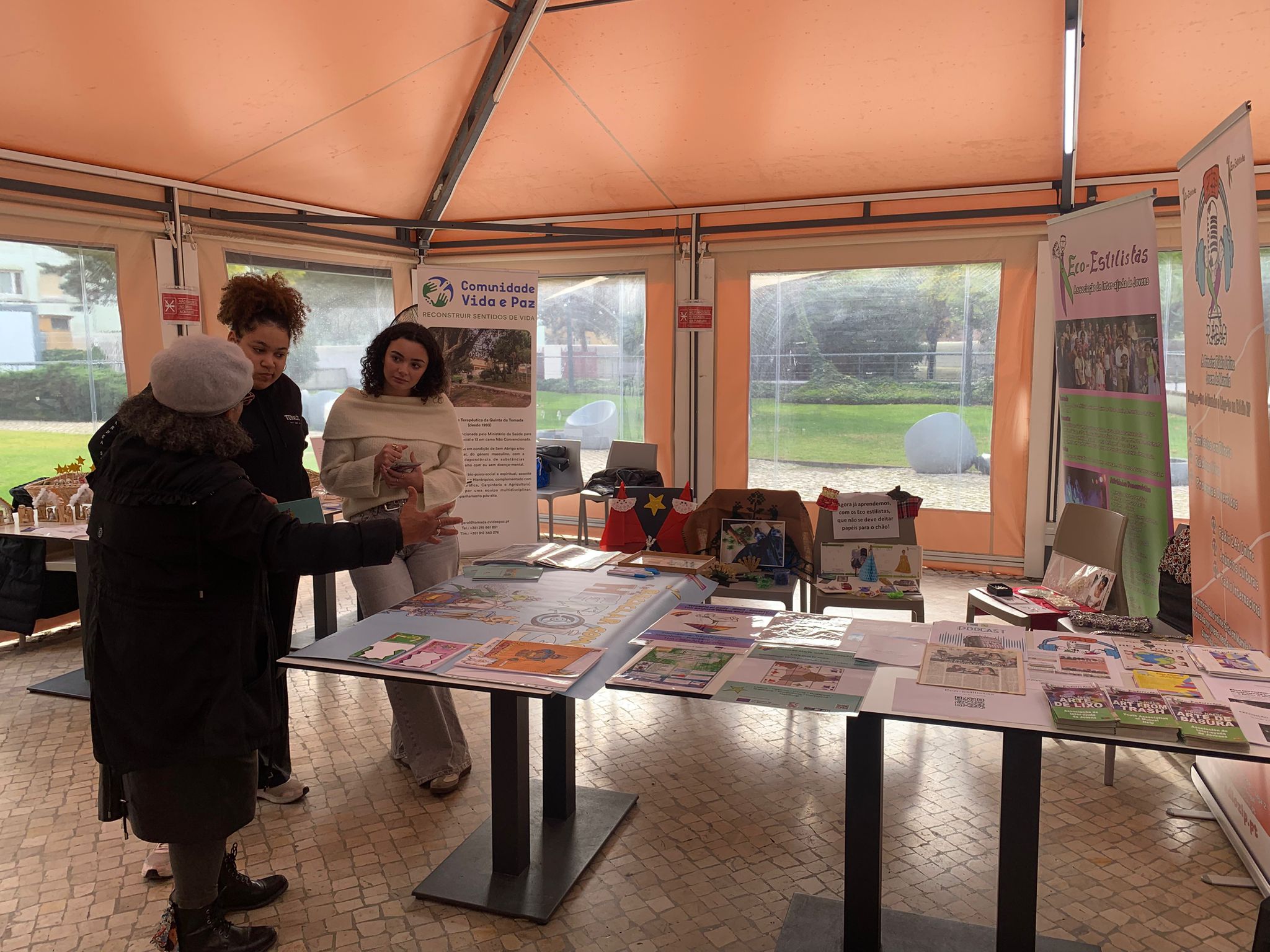
On 4th December, at the Universidade Europeia de Lisboa was held Public Engagement and Volunteer Fair event. Throughout the day, around 100 people moved through the university’s common space on the Carnide campus, engaging with stands, student‑led activities, and volunteer networks. The occasion included the launch of the Universidade Europeia’s Volunteer Scholarship and spotlighted the scientific poster presentation of results from the ODEI TRAINING COURSE – a pilot held from 23 to 27 June 2025.
The poster was presented by Professor Rebeca Rocha and Dr. Rita Freitas, Chief Implementation Officer of Universidade Europeia in the ChallengeEU alliance. Universidade Europeia is the lead university for the ODEI theme and has been working in this area with the eight other universities that make up ChallengeEU.
In the presentation of the poster “DEI Awareness – A Pilot Course Assessment,” Universidade Europeia placed applied science at the heart of the conversation, offering a clear, rigorous account of a pilot that is already transforming practice. The ODEI (Openness, Diversity, Equity & Inclusion) training has evolved into an annual offering for students and staff across the nine universities in the alliance.
The poster succinctly and coherently outlined the course’s pedagogical architecture: six modules delivered over 12 hours, blending theoretical framing with practical applications and reflective activities. The modules cover the essential spectrum of DEI capacity‑building – Introduction to DEI, Self‑Awareness & Unconscious Bias, Intersectionality & Inclusion, Inclusive Communication, Neurodiversity & Accessibility, and From Awareness to Action – aligning concepts, skills, and transfer to real‑world contexts. The hybrid format (in‑person and online), with group/project work, was highlighted as a driver of accessibility and engagement, enabling 46 participants (staff and students) from partner institutions to experience the content in diverse, collaborative settings.
“As a journalist specialized in scientific communication, I underscore the care taken with the learning objectives, clearly mapped to observable outcomes: understanding key concepts (such as unconscious bias, intersectionality, and neurodiversity), critically reflecting on personal bias and its impact on professional practice, demonstrating inclusive communication practices, and designing actionable strategies to strengthen institutional DEI. This taxonomy of objectives reveals a course aimed at behavioral and organizational change, moving beyond awareness into implementation,” says Dr. Rita Freitas.
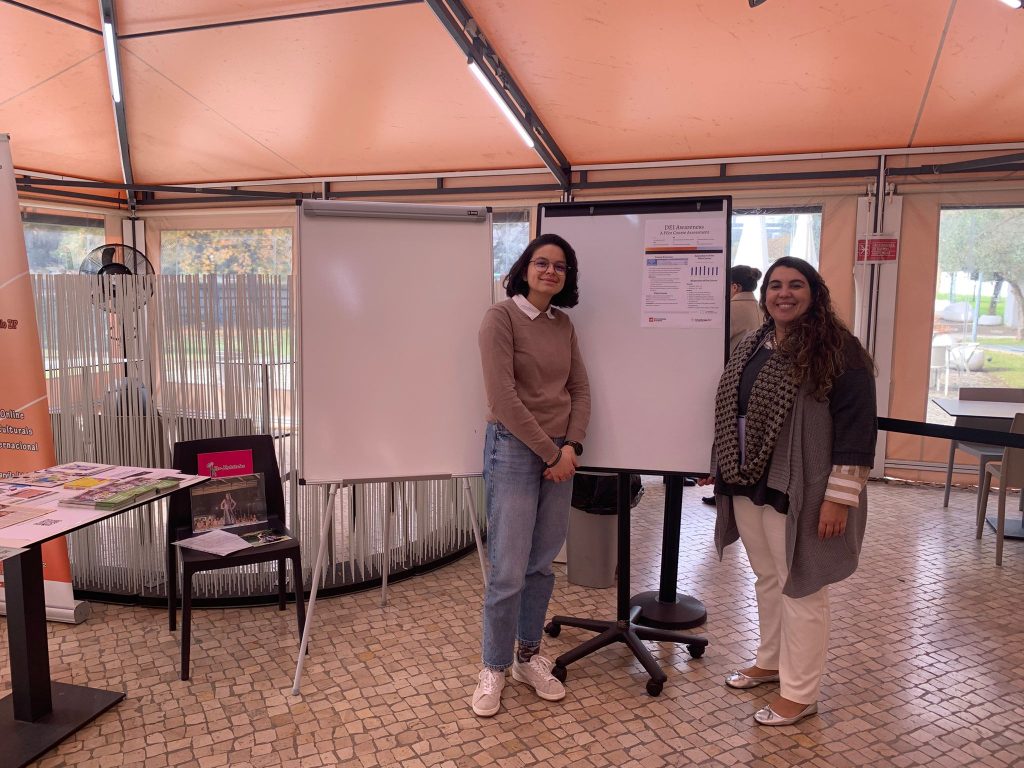
In the evaluation section, the poster presented a bar chart across six dimensions – Relevance, Engagement, Materials, Knowledge, Methods, and Overall – showing consistently high participant satisfaction in all metrics. While explicit numerical values were not displayed, the consistently high profile of the results suggests robust perceived quality and coherence between pedagogical design and classroom experience. This is a crucial indicator for decisions on scaling and institutionalization.
Scientific rigor was equally evident in the continuous improvement section. Based on pilot data, the ChallengeEU DEI team – comprising the nine universities and led by Universidade Europeia – introduced specific adaptations: in Module 1, a stronger focus on key definitions to consolidate a shared language; in Module 2, the inclusion of more real cases, bringing content closer to everyday challenges; in Module 3, additional support materials to diversify learning strategies; in Module 4, adjustments to neurodiversity content for greater precision and breadth; in Module 5, the removal of the gender‑sensitive language topic – a technical decision reflecting careful scope curation; and, in Module 6, changes to activity duration to optimize the balance between practice and synthesis. Notes on timing (such as setting 1h30–2h for Module 1 and revising Module 2 from 3h to 2h30) reinforce that the course is iterative, attentive to cognitive load and the optimal learning pace.
In summary, the poster’s narrative delivered what one expects from effective scientific communication: clarity of exposition, methodological transparency, evidence of results, and plans for improvement. By transforming a pilot into an annual program, Universidade Europeia and ChallengeEU signal a vision of ODEI as a practical competence – to learn, apply, measure, and improve – and offer a replicable model that brings knowledge and action closer together, both on campus and beyond. For those who attended the poster presentation, the takeaway was clear: ODEI Training is not just a course; it is an evidence‑based instrument of change, ready to impact people, teams, and institutions.