Bridging Regions – Connecting Universities: ChallengeEU meets at University of Warmia and Mazury
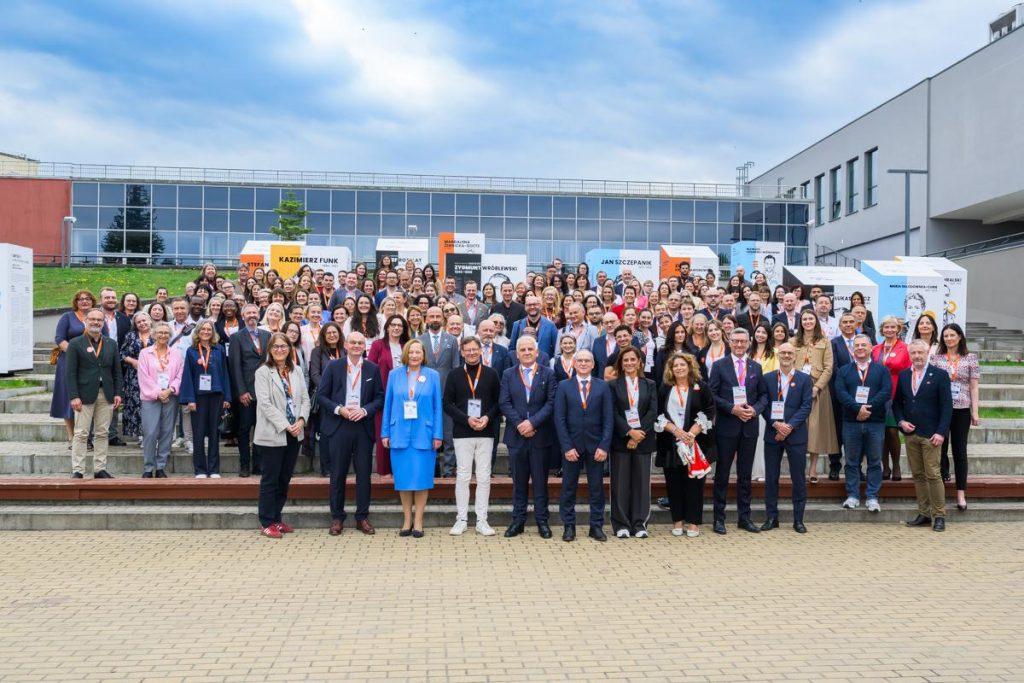
For two days, the University of Warmia and Mazury in Olsztyn became the beating heart of the ChallengeEU Alliance. Created within the framework of the European Universities initiative, ChallengeEU brings together nine institutions from different parts of Europe under a shared banner. Together, they are working on solutions that will support not only their own development, but also the future of European higher education and the regions in which they operate. On 6–7 May, UWM hosted the ChallengeEU 1st Annual Conference. The ChallengeEU Alliance’s journey began several years ago. It brings together Hochschule Offenburg, South East European University, ECAM LaSalle, Mid Sweden University, Universidade Europeia, Latvia University of Life Sciences and Technologies, Universidad Europea de Valencia, Fachhochschule Nordwestschweiz (FHNW) and the University of Warmia and Mazury in Olsztyn. All these universities took on a shared challenge — quite literally — to create an alliance aligned with the idea of European Universities. Achieving this goal meant meeting not only formal requirements. All the work invested in agreeing on a common plan, developing a strategy and addressing many other issues was rewarded with approval to establish the Alliance, which began its activities in 2025. “Faced with a challenge, we basically have two choices: approach or avoid. The fact that we’re all here today shows clearly that not only have we approached our Challenge, but we have also managed it quite well (…). But our Challenge doesn’t stop here; and this ChallengeEU First Annual Conference is not a grand finale; it’s a stepping stone because there’s still work to be done, there are still challenges ahead. We’ll be spending these two days exchanging ideas on how to implement our strategies not only in the world of academia, but also in the communities around us, bridging the gap between regions in the same way as we have bridged the gap between our universities”, reminded Dr Czesław Kiński, the conference host. He added: “Over these two days, we will exchange ideas on how to implement our strategies not only in the academic world, but also in the communities around us, bridging differences between regions in the same way as we bridge differences between our universities.” “Five kilometres from this room, in a red-brick castle on a hill, a young canon once spent his evenings looking at the stars. His name was Nicolaus Copernicus. He lived here, in Warmia, for over forty years. He was not yet famous. He worked, as we might say in the language of today’s funding bodies, ‘based at a regional institution’. And from that so-called regional institution, he moved to the centre of the universe,” said Prof. Jerzy Przyborowski, Rector of the University of Warmia and Mazury in Olsztyn, during the opening of the conference. He stressed that, in his view, the famous Polish astronomer would have understood the idea behind the ChallengeEU Alliance. “Copernicus understood that ‘the centre’ is not a place. It is a question. And whoever is brave enough to ask better questions becomes, for that moment, the centre of the world.. In this hall today, I see representatives of nine universities who have decided to ask better questions. Questions about how regions and universities can support each other. About how the green transition can also be a just transition. About how challenge-based learning can replace lecture-based forgetting. About what European belonging means when the borders of Europe are once again being renegotiated, sometimes peacefully and sometimes not.” What brings the ChallengeEU community together is not only a readiness to ask questions and push boundaries, but also enthusiasm. This was exactly what Prof. Hélia Gonçalves Pereira, Rector of Universidade Europeia in Lisbon, spoke about when welcoming the conference guests on behalf of the Strategy Board. “When we created this alliance, some said that such an undertaking was impossible; others argued that it was possible, but would be very, very difficult. Today, we can proudly say that we have succeeded — that our dream has come true,” said Prof. Hélia Gonçalves Pereira. “ChallengeEU involves more than 90,000 students, teachers, researchers and partners, working in areas that are crucial not only for the universities forming the Alliance, but also for Europe: mobility and cooperation. As we work to make this ecosystem function as effectively as possible, we are accompanied by great enthusiasm. There is no doubt that in these strange, yet exciting times, we need more and better knowledge.” Prof. Stephan Trahasch, Rector of Hochschule Offenburg, the Alliance’s leading institution, drew attention to the goal that had guided the project from the beginning. “When we brought this alliance to life many months ago, we had a clear vision of what we wanted to do: we wanted European universities to cooperate not only on paper, but in practice, and to take on concrete challenges with a real impact on the world around them. What I see today strengthens my belief that the path we have chosen is the right one,” Prof. Trahasch emphasised. The HSO Rector gave a particularly warm welcome to the students taking part in the conference. “You are not guests at this meeting — you are the reason this alliance exists, and you are the heart of this alliance. Every partnership we build and every barrier we overcome is for you and, most importantly, with you. Your energy and commitment are what make this alliance truly European,” said Prof. Trahasch. Universities have an impact The first Annual Conference of the Alliance was held under the motto “Bridging Regions – Connecting Universities”. It referred to the idea from which ChallengeEU has grown, and whose practical expression can be seen in the long-standing partnership between Offenburg and Olsztyn, as well as in the cooperation between Hochschule Offenburg and the University of Warmia and Mazury that emerged from it. This cooperation would not have been possible without Maria and Georg Dietrich, the founders of the foundation which continues to strengthen relations between the two cities and universities to this day. Julia Ritter spoke about her grandfather’s work and her readiness