BIP: Skills for Success and Global Communication. Registration is open

Illustration: Communication skills

The Erasmus+ Blended Intensive Programme (BIP), organised by Latvia University of Life Sciences and Technologies (LBTU), is an international learning experience designed to strengthen students’ key transversal and 21st-century competencies for academic, professional, and global environments. The programme focuses on developing intercultural communication, critical and evidence-based thinking, media and information literacy, and effective teamwork through structured international collaboration and guided interaction in multicultural and interdisciplinary teams. Participants will engage in both online and on-site learning activities, gaining practical experience in working across cultures, disciplines, and digital environments. Students will enhance their ability to communicate clearly and responsibly, evaluate information critically, recognise misinformation and AI-generated content, and collaborate successfully in international academic and professional contexts. The programme is open to students from all academic fields who wish to strengthen their skills for studying, working, and communicating in a globalised world. The blended format combines an online component with an on-site mobility period in Jelgava, Latvia, offering participants valuable exposure to diverse perspectives and international learning environments. >>> Application for Blended Intensive Programme Skills for Success and Global Communication Organiser: Latvia University of Life Sciences and Technologies (LBTU) Location: Jelgava, Latvia Online component: 30 March – 24 April 2026 On-site component: 13–17 April 2026 Registration deadline: 2 February 2026 More information: LBTU’s website Main illustration: Freepik.com

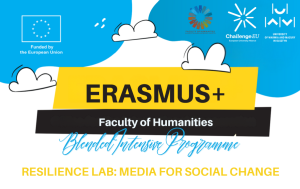
Registration for Blended Intensive Programme (BIP): “Resilience Lab: media for social change”

We are pleased to invite all our partners in the Challenge EU Alliance to participate in the upcoming edition of the Blended Intensive Programme (BIP) “Resilience Lab: Media for Social Change” This BIP brings together students and academic staff from different fields to explore how media shape public opinion and can support positive social change. Focusing on resilience to disinformation, the program combines online sessions with an intensive on-site module, enabling participants to critically analyze information and create responsible, impactful media content. Program Dates:  Virtual sessions: May 4th, 2026 On-site component in Olsztyn: May 11-15, 2026 We are looking for Bachelor, Master & PhD students in the humanities and social sciences. You are also warmly invited to contribute as a lecturer, mentor, or session leader, if interested – we’d be thrilled to co-design this experience with you. We kindly ask each partner to confirm their willingness to participate by January 23th, 2026 and to select and confirm their students by February 23th, 2026, so we can proceed with the necessary coordination for logistics and team formation. For more information, please find the BIP Invitation Flyer Resilience Lab – Media for Social Change UWM. Should you have any questions or need further clarification, we are at your disposal. Contact:  Erasmus+ Institutional Coordinator: Anna Dąbrowska: ania.dabrowska@uwm.edu.pl Erasmus Faculty Coordinator: Czesław Kiński: czeslaw.kinski@uwm.edu.pl Course Contact: Marta Więckiewicz-Archacka: marta.wieckiewicz@uwm.edu.pl  

ODEI Programme in Action

Participants of ODEI BIP in Lisbon

From June 20 to 30, members of Work Package 5 from the ChallengeEU Alliance conducted an innovative pilot training on Openness, Diversity, Equity, and Inclusion. The immersive Blended Intensive Programme (BIP), hosted by Universidade Europeia, brought together participants from all partner universities, offering a unique opportunity to develop and refine their teaching skills on key ODEI topics. After several weeks of in-depth preparation, the training provided a dynamic platform to put their knowledge into practice. The training was structured into six interactive modules, each addressing key aspects of ODEI: A standout feature of the training was the ODEI simulation, where participants engaged in experiential learning by observing actors role-playing real-life scenarios involving discrimination and microaggressions. This powerful exercise sparked deep discussions, allowing attendees to analyze these situations and collaboratively explore solutions. While the opening and closing sessions were held online, the core of the training took place in a hybrid format, combining virtual participation with an in-person gathering in Lisbon, Portugal. This blended approach not only made the program accessible to a wider audience but also provided an invaluable opportunity for participants to network, exchange ideas, and strengthen cross-university partnerships. The training employed diverse, interactive methods – including experiential learning, Mentimeter polls, group discussions, and brainstorming sessions – to ensure active participation. The final evaluations reflected high satisfaction with the content, materials, and facilitation methods, demonstrating the program’s effectiveness in deepening ODEI competencies. Building on this successful pilot, the next phase will involve rolling out the training to students and staff across all ChallengeEU universities. This expansion will further embed ODEI principles into institutional cultures, empowering more individuals to champion inclusivity and equity in their communities. This initiative marks a significant step forward in creating more inclusive, aware, and collaborative academic environments – a testament to the power of shared learning and collective action.
LBTU hosts programme “Media Literacy for Future Leaders”

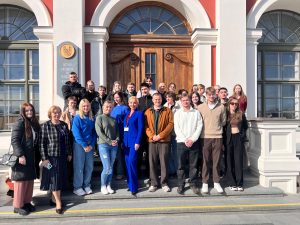
Participants of the “Media Literacy for Future Leaders” programme / fot. LBTU

The Institute of Social and Humanitarian Sciences of the Faculty of Economics and Social Development (ESAF) at the Latvia University of Life Sciences and Technologies (LBTU) has successfully completed the Erasmus+ Blended Intensive Programme (BIP) project “Media Literacy for Future Leaders”. Among the participants were students and lecturers from ChallengeEU partner universities — Hochschule Offenburg, University of Warmia and Mazury in Olsztyn, and South East European University (SEEU) — joined by representatives of the Estonian University of Life Sciences. The program was led by an international team of lecturers, including five LBTU faculty members from ESAF and guest lecturers – professor Edlira Palloshi Disha from North Macedonia, media science professor Urszula Doliwa, and associate professor Magdalena Szydłowska from Poland. The programme focused on media literacy, critical thinking, and intercultural communication — equipping students with tools to analyze digital content, detect disinformation, and craft meaningful messages. Following an initial online seminar, participants gathered for a vibrant study week in Jelgava, featuring hands-on workshops, cultural visits to Riga and Rundāle Palace, and student presentations during the international conference “Students on Their Way to Science”. It was a great experience, as reflected in the words of one of the participants: “I would like to sincerely thank you for the wonderful experience during the Blended Intensive Programme in Latvia. It was an incredibly enriching opportunity, both academically and personally. I am truly grateful for the chance to participate, to meet inspiring peers, and to learn from outstanding professors. The organization and hospitality throughout the programme were exceptional. I truly appreciate all the efforts that made this an unforgettable experience”. >>> More information

This site uses cookies. Visit our cookies policy page or click the link in footer for more information and to change your preferences.