Family Law through ODEI M.A.R.K.E.T.: Student Perspectives

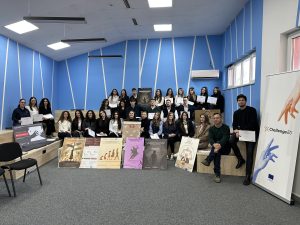
Students, mentors and staff from SEEU pose together holding certificates and showcasing their posters created within the “Family Law through ODEI M.A.R.K.E.T.: Student Perspectives” event, under the ChallengeEU banner.

The event “Family Law through ODEI M.A.R.K.E.T.: Student Perspectives”, organised as part of ChallengeEU, is a compelling example of how innovative, inclusive and student-centred learning can generate meaningful academic and societal impact at South East European University (SEEU). The event opened with remarks from Prof. Dr Arta Mero, who emphasised the pedagogical value of the ODEI M.A.R.K.E.T. approach in fostering student advocacy, critical thinking and socially engaged legal education. This was followed by a welcome address from Prof. Dr. Veli Kreci, Director of the Max van der Stoel Institute, who highlighted the importance of embedding openness, diversity, equity, and inclusion into academic practice and curricula, particularly within the framework of the ChallengeEU Alliance. Representing the student perspective, Mevlan Ademi, Student Ambassador for ChallengeEU, reflected on the role of students as active contributors to university initiatives and European academic collaboration, underscoring how such formats empower students to engage meaningfully with societal challenges. Through the ODEI M.A.R.K.E.T. framework (Multi-Actor Research, Knowledge, Exchange, Teams), students moved beyond traditional classroom learning to become active researchers, presenters, and contributors to public and academic discourse. Their work demonstrated not only strong legal knowledge but also critical reflection, ethical awareness, and social sensitivity, particularly in addressing family law challenges through the lenses of diversity, equity, openness, and inclusion. The integration of the M.A.R.K.E.T. model in Family Law confirms its value as a sustainable, inclusive, and high-impact educational approach, enhancing academic excellence while strengthening the social relevance of legal education. The event also highlighted the transformative role of academic staff and fourth-year student mentors, whose guidance and commitment enabled participating students to translate theoretical knowledge into practice-oriented and socially responsive legal analysis. This collaborative effort reflects SEEU’s core values and reinforces its position as a leading institution within the European University Alliance, actively shaping modern, responsible and inclusive higher education. Presentations on adoption, domestic violence, child marriage, post-divorce parental responsibilities, children’s participation in legal proceedings and evolving approaches to divorce were delivered by: Albina Pajaziti, Sara Besimi, Era Fejzullai, Arion Dauti, Erjon Murseli; Iva Stefanovska, Bojana Velkovska, Emanuela Dimovska, Suejla Sulejmani, Zahide Hajdari, Drita Emini, Sara Vejseli; Aida Selami, Fatime Sejfuli, Leonita Xhelili, Mimoza Jahiu; Erlind Rufati, Valon Bexheti; Lindihana Uzeiri, Amina Iljazi, Eugerta Selami; and Jehona Saiti, Albina Rexhepi and Djellza Pajaziti, under the mentorship of Elisa Murseli, Mila Arsić, Elsa Havziju, Amina Ademi, Elfatir Lloga, Mevlan Ademi, Era Sadiku and Omer Ajruli (fourth-year students). The presentations were followed by an open and dynamic debate, during which students, mentors, and participants discussed research challenges, the role of mentoring, and emerging perspectives for family law within the ODEI framework, further enriching the academic exchange and reinforcing the participatory nature of the initiative. Strong engagement from legal practitioners (attorneys, notaries and judges), NGOs, institutional representatives, and students from other faculties and universities significantly amplified the event’s impact. Stakeholders welcomed the initiative and described it as a unique and rarely seen format in the legal field, emphasising its value in bridging academia and practice. As key collaborators of SEEU, they recognised the importance of such initiatives in advancing legal scholarship and strengthening societal trust in the legal system. The event concluded with a certificate ceremony, recognising the commitment and academic contribution of all participating students and mentors. Overall, this initiative confirms that ODEI M.A.R.K.E.T. within the ChallengeEU framework is not merely a project activity but a sustainable educational model, one that empowers students as agents of change, strengthens academic practice, and positions SEEU as a hub of inclusive, forward-looking, and socially responsible higher education with a tangible impact on both society and academia.
Public Engagement and Volunteer Fair: applied science and civic participation

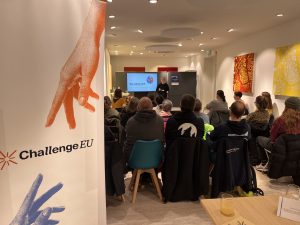
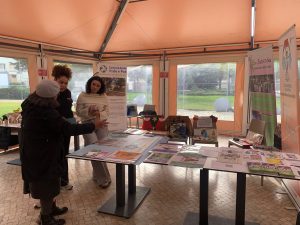
On 4th December, at the Universidade Europeia de Lisboa was held Public Engagement and Volunteer Fair event. Throughout the day, around 100 people moved through the university’s common space on the Carnide campus, engaging with stands, student‑led activities, and volunteer networks. The occasion included the launch of the Universidade Europeia’s Volunteer Scholarship and spotlighted the scientific poster presentation of results from the ODEI TRAINING COURSE – a pilot held from 23 to 27 June 2025. The poster was presented by Professor Rebeca Rocha and Dr. Rita Freitas, Chief Implementation Officer of Universidade Europeia in the ChallengeEU alliance. Universidade Europeia is the lead university for the ODEI theme and has been working in this area with the eight other universities that make up ChallengeEU. In the presentation of the poster “DEI Awareness – A Pilot Course Assessment,” Universidade Europeia placed applied science at the heart of the conversation, offering a clear, rigorous account of a pilot that is already transforming practice. The ODEI (Openness, Diversity, Equity & Inclusion) training has evolved into an annual offering for students and staff across the nine universities in the alliance. The poster succinctly and coherently outlined the course’s pedagogical architecture: six modules delivered over 12 hours, blending theoretical framing with practical applications and reflective activities. The modules cover the essential spectrum of DEI capacity‑building – Introduction to DEI, Self‑Awareness & Unconscious Bias, Intersectionality & Inclusion, Inclusive Communication, Neurodiversity & Accessibility, and From Awareness to Action – aligning concepts, skills, and transfer to real‑world contexts. The hybrid format (in‑person and online), with group/project work, was highlighted as a driver of accessibility and engagement, enabling 46 participants (staff and students) from partner institutions to experience the content in diverse, collaborative settings. “As a journalist specialized in scientific communication, I underscore the care taken with the learning objectives, clearly mapped to observable outcomes: understanding key concepts (such as unconscious bias, intersectionality, and neurodiversity), critically reflecting on personal bias and its impact on professional practice, demonstrating inclusive communication practices, and designing actionable strategies to strengthen institutional DEI. This taxonomy of objectives reveals a course aimed at behavioral and organizational change, moving beyond awareness into implementation,” says Dr. Rita Freitas. In the evaluation section, the poster presented a bar chart across six dimensions – Relevance, Engagement, Materials, Knowledge, Methods, and Overall – showing consistently high participant satisfaction in all metrics. While explicit numerical values were not displayed, the consistently high profile of the results suggests robust perceived quality and coherence between pedagogical design and classroom experience. This is a crucial indicator for decisions on scaling and institutionalization. Scientific rigor was equally evident in the continuous improvement section. Based on pilot data, the ChallengeEU DEI team – comprising the nine universities and led by Universidade Europeia – introduced specific adaptations: in Module 1, a stronger focus on key definitions to consolidate a shared language; in Module 2, the inclusion of more real cases, bringing content closer to everyday challenges; in Module 3, additional support materials to diversify learning strategies; in Module 4, adjustments to neurodiversity content for greater precision and breadth; in Module 5, the removal of the gender‑sensitive language topic – a technical decision reflecting careful scope curation; and, in Module 6, changes to activity duration to optimize the balance between practice and synthesis. Notes on timing (such as setting 1h30–2h for Module 1 and revising Module 2 from 3h to 2h30) reinforce that the course is iterative, attentive to cognitive load and the optimal learning pace. In summary, the poster’s narrative delivered what one expects from effective scientific communication: clarity of exposition, methodological transparency, evidence of results, and plans for improvement. By transforming a pilot into an annual program, Universidade Europeia and ChallengeEU signal a vision of ODEI as a practical competence – to learn, apply, measure, and improve – and offer a replicable model that brings knowledge and action closer together, both on campus and beyond. For those who attended the poster presentation, the takeaway was clear: ODEI Training is not just a course; it is an evidence‑based instrument of change, ready to impact people, teams, and institutions.

Family Law through ODEI M.A.R.K.E.T.: Student Perspectives

Colleagues working together while sitting in cafe

Family Law through ODEI M.A.R.K.E.T.: Student Perspectives is an academic and creative showcase designed for students of the Faculty of Law, university staff, and invited stakeholders. Family Law through ODEI M.A.R.K.E.T.: Student Perspectives is a dynamic academic event, organized within the ChallengeEU Project, designed to bring together students, mentors, university staff, and key stakeholders from the legal and social sectors. The showcase presents student-led research on essential topics in family law through the principles of Openness, Diversity, Equity, and Inclusion (ODEI) and the guiding pillars of the M.A.R.K.E.T. model: Multi-actor collaboration: engaging students, mentors, faculty, legal professionals, NGOs, and community members Knowledge exchange: enabling open dialogue between academia, practice, and community sectors Team-based learning: strengthening teamwork, communication, and critical thinking within student groups and mentors Research engagement: encouraging analytical exploration of Family Law through ODEI frameworks Cross-sector participation: Promoting inclusive perspectives in legal education and policy reflection Students will present their work through poster, research presentations and policy-oriented reflection. This event will: Promotes inclusive and modern legal education Strengthens research, presentation, and advocacy skills  Encourages dialogue on equality, justice, and human rights Connects students with professionals and institutions Prepares future jurists for ethical, critical, and inclusive practice Participants of the event: University students (SEEU and other universities) High school students and professors Academic and administrative staff of SEEU Law professionals NGO representatives Judges, Attorneys, Notaries
Orange for Awareness at SEEU: Empowering Law Students Against Gender-Based Violence

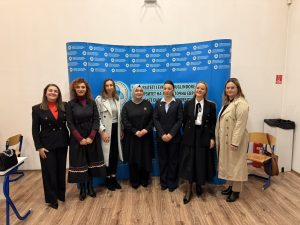
Group photo of seven women standing in front of a blue SEEU Faculty of Law backdrop during the “Orange for Awareness” seminar.

South East European University (SEEU), through its Faculty of Law and the ODEI Working Group (Openness, Diversity, Equity, and Inclusion) of the ChallengeEU project, launched the 16 Days of Activism Against Gender-Based Violence with the seminar “Orange for Awareness: Empowering Law Students Against Gender-Based Violence.” This year’s global theme, “UNiTE to End Digital Violence Against All Women and Girls”, guided the keynote messages and discussions throughout the event. The seminar opened with remarks by Prof. Dr. Arta Mero, who emphasized the importance of preparing future legal professionals to address both physical and digital forms of violence against women and girls. She highlighted SEEU’s ongoing commitment to fostering a safe, inclusive, and supportive academic environment for all students. The event brought together law students, academic staff, NGOs, gender-based violence activists, and participants from ChallengeEU partner universities who joined online. The presence of SEEU’s leadership demonstrated strong institutional support: Rector Prof. Dr. Sadudin Ibrahimi, Pro-Rector Prof. Dr. Veland Ramadani, and Prof. Dr. Besa Arifi, Advisor for Community and International Relations. The seminar featured a series of powerful contributions from experts and practitioners in the field. Vilma Dule, activist and survivor of gender-based violence, offered a deeply personal and academic reflection in her presentation “Rebirth as an Act of Resistance.” Elizabeta Bozhinovska, Programme Director at HERA, highlighted the importance of comprehensive services for victims, perpetrators, and men in crisis. From the University of Tetova, Prof. Dr. Hana Saliu discussed the psychological impacts of gender-based violence and the therapeutic interventions available to survivors. SEEU’s Prof. Dr. Albana Meta-Stojanova examined the alarming rise of femicide in her talk “Femicide: Chronicle of a Foretold Murder,” while Prof. Dr. Vedije Ratkoceri provided an overview of the criminal legal framework for protection against gender-based violence and its alignment with international standards. A special highlight of the event was the acknowledgment of the “Emine Zendeli” Legal Clinic, which supports victims of gender-based violence through primary legal assistance and offers students essential practical training and real-case experience. Today’s seminar reaffirmed that gender-based violence is not only a legal or institutional challenge, but a shared social responsibility. Only through cooperation among universities, institutions, organizations, activists, and students can we build a safer, fairer, and more humane society. SEEU and ChallengeEU remain committed to safeguarding human rights and standing united against all forms of gender-based violence. Together, we rise against gender-based violence.

Orange for Awareness: Empowering Law Students Against Gender-Based Violence

Stylised orange background with a large pale handprint and a white awareness ribbon curving across the image

This seminar is organized within the framework of the ChallengeEU project, as part of the ODEI Working Group (WP5), which aims, among other objectives, to strengthen students’ capacities in addressing gender-based violence. “Orange for Awareness” is an activity that brings together professionals from the legal system, mental health, civil society, and activism to create a shared space for education, reflection, and awareness on one of the most serious human rights challenges. Aligned with the 2025 theme of the 16 Days of Activism Against Gender-Based Violence  “UNiTE to End Digital Violence Against All Women and Girls”, the seminar emphasizes the growing importance of combating violence in both physical and digital spaces. It aims to equip students with legal, psychological, and practical knowledge, preparing them to become professionals committed to justice, victim protection, and fostering social change. The Legal Clinic “Emine Zendeli”, through its role in providing primary legal assistance, enables students to respond professionally to real cases of gender-based violence, strengthening the connection between theory, practice, and ethical engagement in the protection of human rights. Join online: https://meet.google.com/upq-ikjb-ena Involved institutions and partners: Max Vander Stoel Institute; Cortex; Mollekuqja, Margini, Hera; Shega; Centre for Women Support  

ODEI Programme in Action

Participants of ODEI BIP in Lisbon

From June 20 to 30, members of Work Package 5 from the ChallengeEU Alliance conducted an innovative pilot training on Openness, Diversity, Equity, and Inclusion. The immersive Blended Intensive Programme (BIP), hosted by Universidade Europeia, brought together participants from all partner universities, offering a unique opportunity to develop and refine their teaching skills on key ODEI topics. After several weeks of in-depth preparation, the training provided a dynamic platform to put their knowledge into practice. The training was structured into six interactive modules, each addressing key aspects of ODEI: A standout feature of the training was the ODEI simulation, where participants engaged in experiential learning by observing actors role-playing real-life scenarios involving discrimination and microaggressions. This powerful exercise sparked deep discussions, allowing attendees to analyze these situations and collaboratively explore solutions. While the opening and closing sessions were held online, the core of the training took place in a hybrid format, combining virtual participation with an in-person gathering in Lisbon, Portugal. This blended approach not only made the program accessible to a wider audience but also provided an invaluable opportunity for participants to network, exchange ideas, and strengthen cross-university partnerships. The training employed diverse, interactive methods – including experiential learning, Mentimeter polls, group discussions, and brainstorming sessions – to ensure active participation. The final evaluations reflected high satisfaction with the content, materials, and facilitation methods, demonstrating the program’s effectiveness in deepening ODEI competencies. Building on this successful pilot, the next phase will involve rolling out the training to students and staff across all ChallengeEU universities. This expansion will further embed ODEI principles into institutional cultures, empowering more individuals to champion inclusivity and equity in their communities. This initiative marks a significant step forward in creating more inclusive, aware, and collaborative academic environments – a testament to the power of shared learning and collective action.

This site uses cookies. Visit our cookies policy page or click the link in footer for more information and to change your preferences.