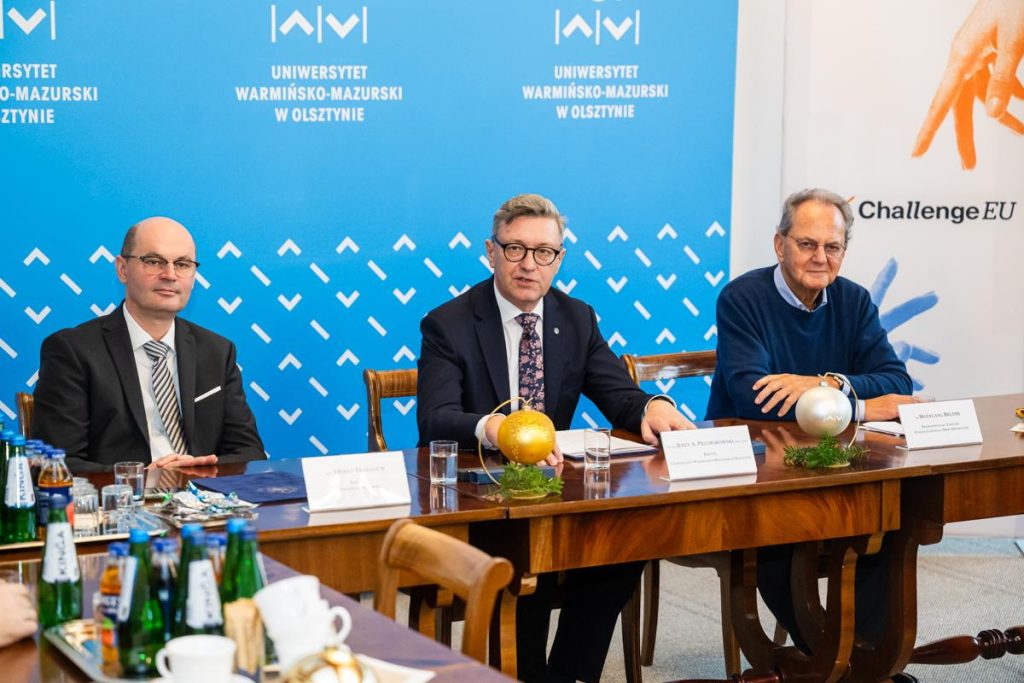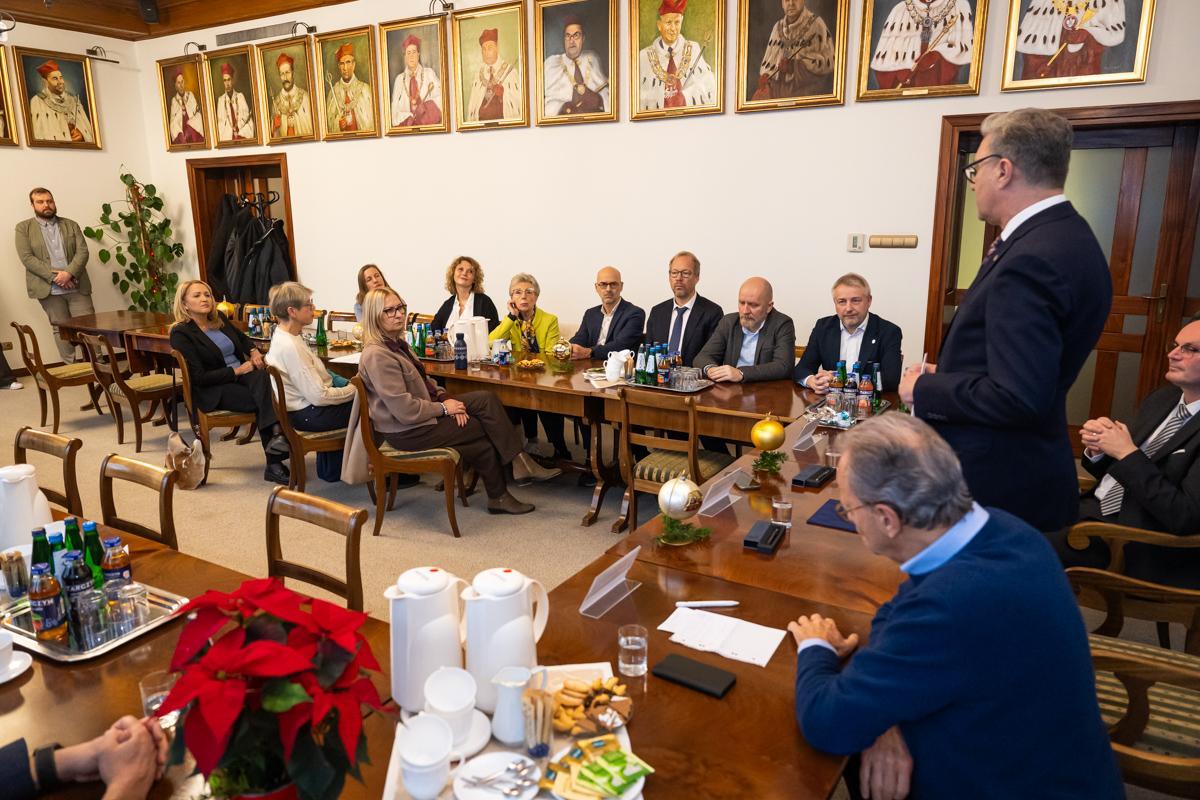
On Monday, 8 December, the University of Warmia and Mazury was visited by guests from Hochschule Offenburg and the Maria and Georg Dietrich Foundation. The pre-Christmas meeting is a tradition that strengthens the ties between the two partner universities. It was, among other things, this friendship that gave rise to the ChallengeEU Alliance.
The annual UWM–HSO meeting is a tradition. Professor Jerzy Przyborowski, Rector of the University of Warmia and Mazury (UWM), welcomed the delegation in the rector’s office building, saying: “I am very grateful that we can meet every year as part of the Christmas Bridge initiative, launched by Georg Dietrich. It is a true symbol of friendship between our institutions, but also between all the people involved.” Both the host and the guests emphasised that good relations between countries are more important than ever in the face of the ongoing war in Ukraine and many other geopolitical threats. “Thank you very much for this wonderful welcome during Advent. For us, this is not an official visit – it is a visit to friends. This friendship is a prerequisite for successful cooperation, because something good usually grows out of human relationships,” said Prof. Dr Stephan Trahasch, Rector of Hochschule Offenburg (HSO).
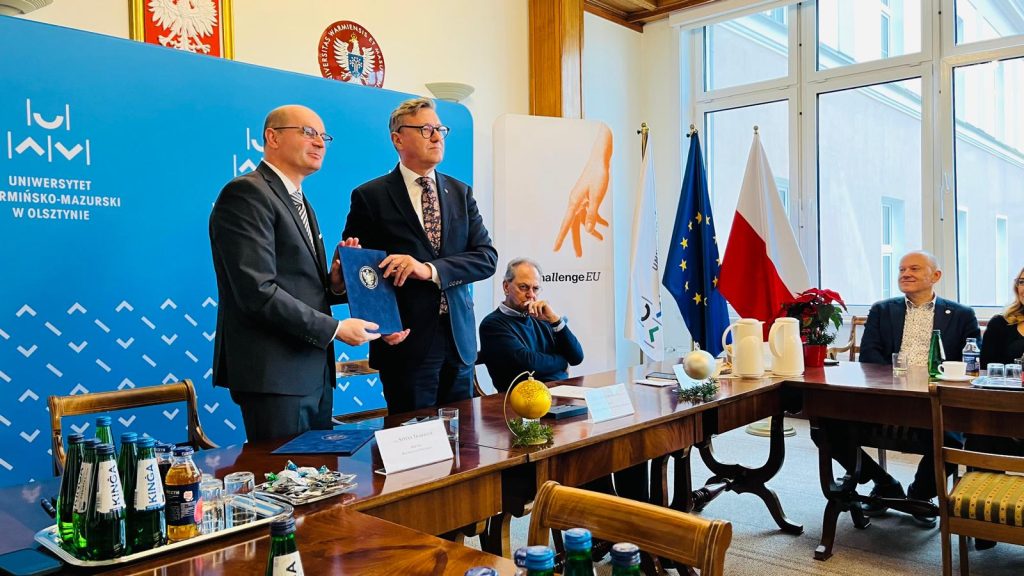
Participants in the meeting underlined that what has particularly strengthened the friendship between the University of Warmia and Mazury and Hochschule Offenburg in recent times is the fact that both universities are members of the ChallengeEU European Universities Alliance.
The ChallengeEU Alliance places strong emphasis on student mobility. “Exchange and cooperation among young people form the foundation of unity between nations, and thus of peace in Europe,” explained Stephan Trahasch. During the meeting, discussions on joint initiatives within the ChallengeEU Alliance were continued. Prof. Dr Tobias Hagen, Vice-Rector for Internationalisation at Hochschule Offenburg and Chair of the ChallengeEU Alliance, spoke, among others, with Professor Paweł Wielgosz, the UWM Rector’s Representative for European Universities, about new joint educational programmes and academic cooperation – especially in the field of research.
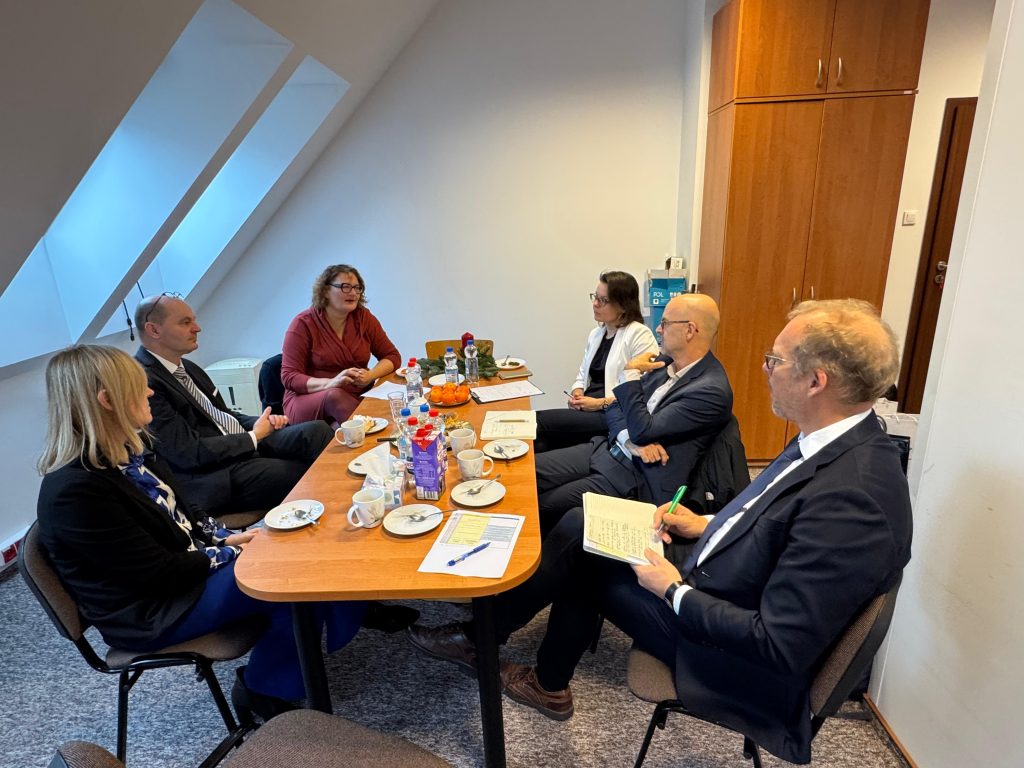
“The project has only just started, but we already have our first results – our academic staff have taken part in joint training sessions, and in recent days students, including from our university, met in Offenburg,” said Prof. Paweł Wielgosz. “We are preparing to launch new joint study programmes – not only with HSO, but also with other partner universities. It is also very important to me that we can conduct scientific research together. From experience, I know that effective academic cooperation is often born precisely from joint research. I hope that our working meetings will lead to ideas for new study programmes and new areas of scientific collaboration.”
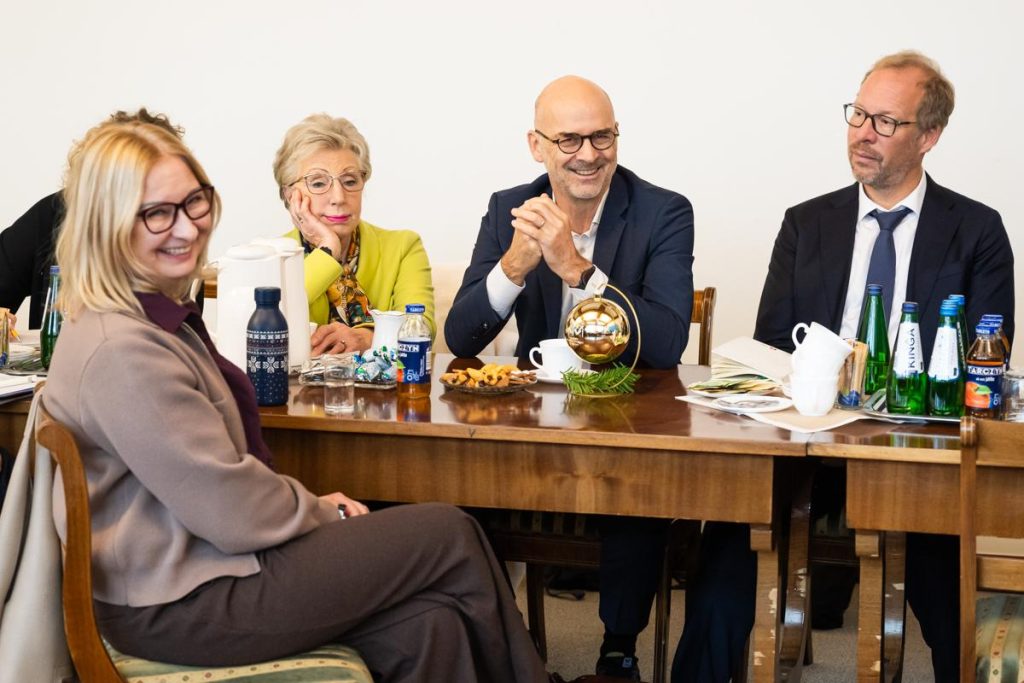
As Prof. Dr Stephan Trahasch recalled, in addition to cooperation within the ChallengeEU Alliance and its other dimensions, what connects UWM and HSO is joint education. The universities run two programmes at the Faculty of Geoengineering (Environmental Engineering in the field of Process Engineering and Biotechnology) and one at the Faculty of Food Science (Food Technology and Human Nutrition in the field of Food Engineering). They also cooperate in programmes such as German Studies and Business Linguistics, in which students also learn German.
Prof. Dr Tobias Hagen, who took part in several ChallengeEU working meetings during his stay at UWM (including one devoted to the conference planned for May to summarise the Alliance’s first year of activities), noted that discussions within the ChallengeEU team and with the Faculties of Economics, Geoengineering and Food Science were intensive, extremely fruitful and constructive, and took place in a very friendly atmosphere. He was convinced that this would enable us to further develop the long-standing partnership between our universities and that there would be many new ideas for the future.
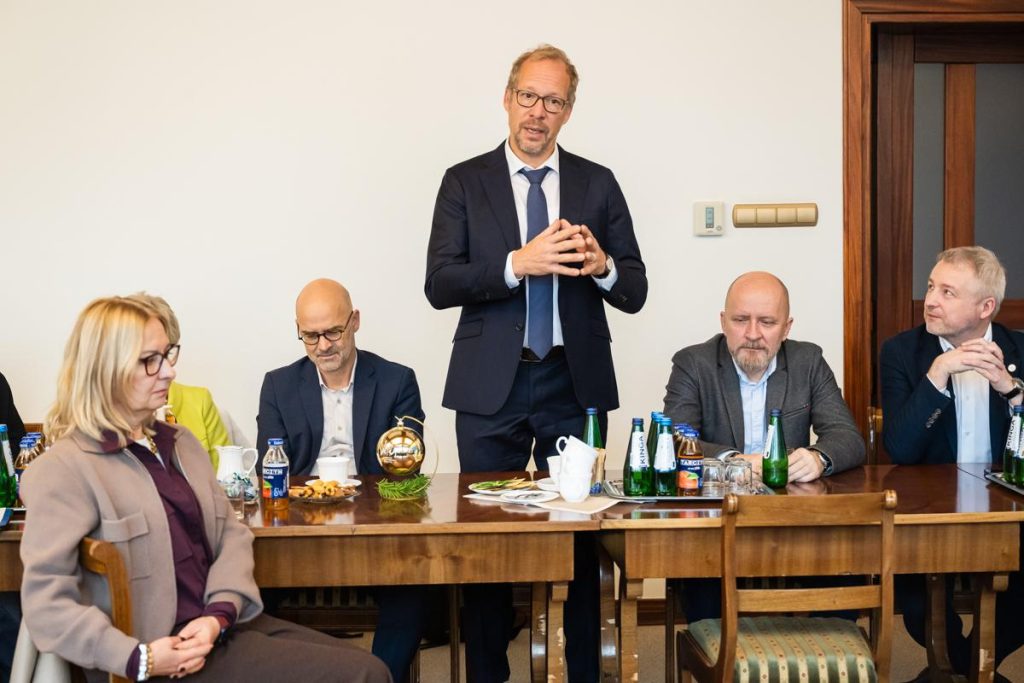
The HSO delegation also included Prof. Dr Jens Pfafferott (Dean of the Faculty of Mechanical Engineering and Process Engineering in Offenburg), who had the opportunity to meet with UWM representatives to discuss possibilities for further cooperation.
Dr Wolfgang Bruder, Chairman of the Georg and Maria Dietrich Foundation, noted that over the years the foundation has awarded more than 200 scholarships to UWM students, contributing to broadening knowledge, creating better learning conditions, and deepening cooperation. In this way, it continues the ideas of Georg Dietrich, who already decades ago deeply understood the importance of Polish–German cooperation and was committed to ensuring that it also developed at university level.