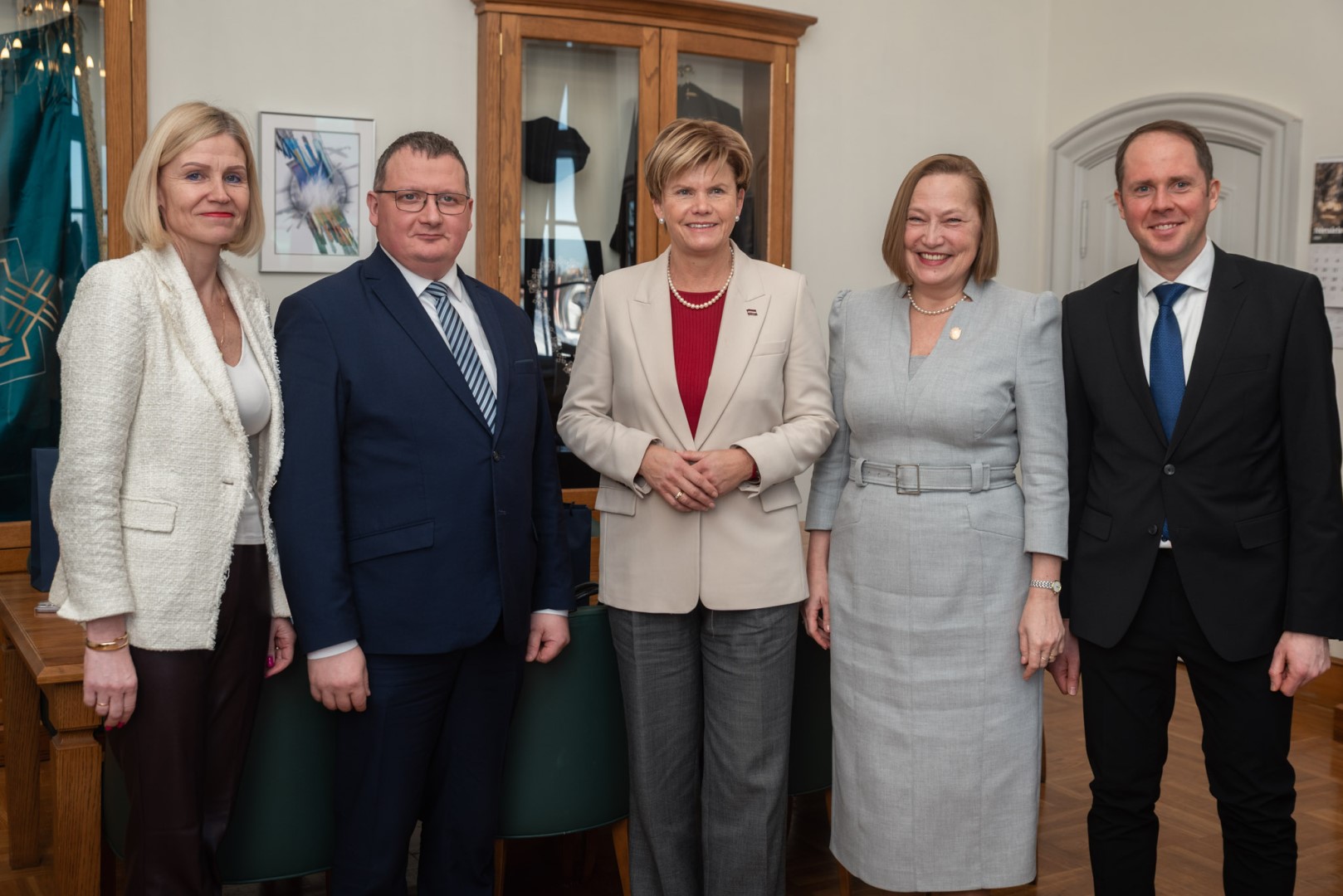
On 2 February, the Latvia University of Life Sciences and Technologies (LBTU) welcomed a delegation from the Ministry of Foreign Affairs of Latvia led by Minister of Foreign Affairs Baiba Braže. During the visit, the delegation ознакомed itself with the University’s research, innovation, and infrastructure potential and participated in discussions on future cooperation opportunities. A seminar on the European Union’s Multiannual Financial Framework for 2028–2034 was also held as part of the visit.
The delegation met with LBTU Rector Irina Arhipova, Vice-Rector for Research Gatis Vītols, Vice-Rector for Finance Linards Sisenis, Vice-Rector for Studies Ilze Beitāne, as well as faculty deans and academic staff. The presentation highlighted LBTU’s role as a driver of innovation in Latvia’s economy and export sectors. The University focuses on life sciences, food technologies, forestry, and veterinary medicine, developing interdisciplinary solutions for sustainable bioeconomy, precision agriculture, and food innovation, as well as dual-use knowledge and technologies for health and defense sectors.
During the visit, the delegation toured faculty laboratories, including a demonstration of dry ration meals developed by LBTU and used by the Latvian National Armed Forces. These rations are specially designed, hermetically sealed food products with balanced nutritional value and long shelf life, intended for use in field conditions for both military and civil protection needs in situations where freshly prepared food is not available.
The delegation also visited the Faculty of Forest and Environmental Sciences, where they familiarized themselves with the renovated and equipped shelters in Jelgava. A discussion addressed bureaucratic challenges related to the establishment of shelters and the adaptation of premises for civil protection purposes, as well as opportunities for cooperation with industry in the areas of education, research, and infrastructure modernization.
At the Faculty of Engineering and Information Technologies, the delegation toured the newly established Drone Laboratory. Discussions focused on the role of higher education institutions in strengthening national security, including the development of competencies in unmanned aerial vehicle (UAV) applications. State support opportunities for training instructors and pilots, as well as the practical application of unmanned technologies in security and crisis management contexts, were also highlighted.
The visit concluded with a meeting with the University’s leadership at Jelgava Palace, where opportunities for further cooperation were discussed. A seminar and discussion on the European Union’s Multiannual Financial Framework for 2028–2034 was also held, with participation from representatives of non-governmental organizations, stakeholders, and other interested parties.
The seminar addressed key challenges and opportunities for Latvia to maximize funding in the next EU budget period. Given that Latvia’s share of the budget is relatively small, attention was paid to securing additional funding within the national financing framework, particularly in light of security and defense considerations in border states. The main difficulties relate to convincing net contributor countries to increase their contributions to the EU budget and to allocate additional funding to other Member States. Various budget headings were also discussed, such as competitiveness programmes, under which Latvia may apply for additional EU funding outside the national allocation framework. It was emphasized that success will largely depend on cooperation with other Member States, negotiations, and proactive engagement.