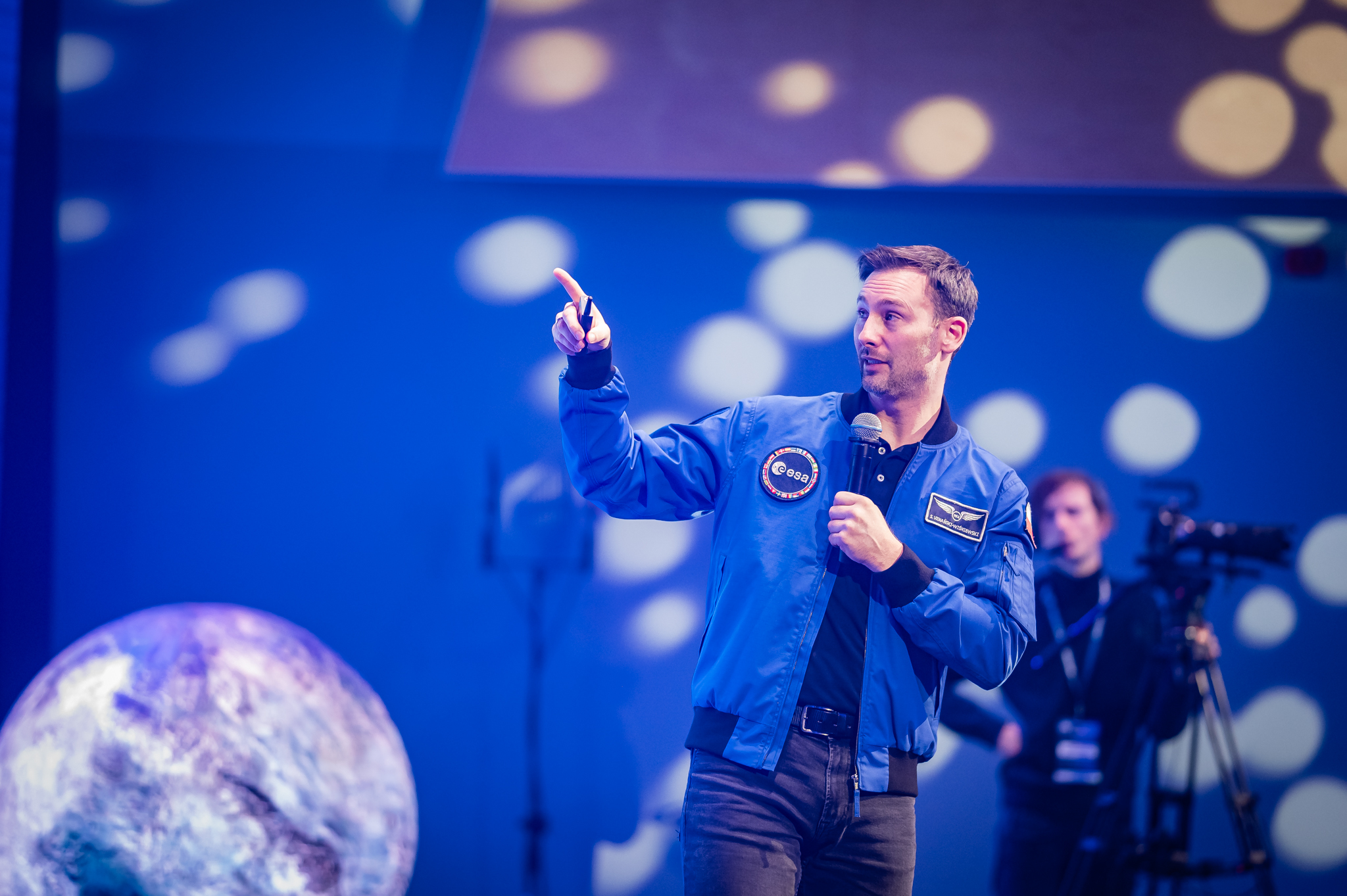
On Tuesday, 2 December, the University of Warmia and Mazury in Olsztyn (UWM) became part of the nationwide science-and-technology tour “IGNIS – Poland Reaches for the Stars.” The campus in Kortowo welcomed Dr. Sławosz Uznański-Wiśniewski an engineer and scientist and the second Pole to travel into space who came to Olsztyn on a mission to popularise science and share first-hand experience from an international spaceflight.
“Exactly 160 days ago on 25 June at 8:51 a.m. the IGNIS mission launched from Cape Canaveral,” said Mariusz Korpoliński, who hosted the event at UWM’s Conference Centre as he introduced the guest he called a “superhero.” “Four astronauts set off on a long journey to the International Space Station. The flight carried out by Axiom Space in cooperation with SpaceX and NASA was followed by the entire country. We were all watching on TVs, tablets, smartphones and computers, living through those huge emotions together.”
Beyond “sky is the limit”
In an era when “sky is the limit” keeps expanding into new areas of everyday life, space is increasingly less a boundary and more a destination shaped by technology, research and imagination. Uznański-Wiśniewski’s visit to UWM was designed to make that world not only more accessible to science, but also more relatable to the public.
Speaking in Kortowo, he outlined the course of his mission, described the work he carried out aboard the station and most importantly-argued that science is both a tool for understanding the world and a pathway to fulfilling personal ambitions. Drawing on his own story, he stressed that work can become a true passion-something worth pursuing wholeheartedly and encouraged students and researchers to follow their goals with consistency and courage.
Don’t predict the future – build it
Welcoming the astronaut to the university, UWM Rector Prof. Jerzy Przyborowski invoked Peter Drucker’s famous observation that the best way to predict the future is to create it. He argued that UWM is doing exactly that among other things through its engagement in research linked to space and radio astronomy.
As the rector noted, on the same day Uznański-Wiśniewski flew into space, UWM together with partners launched Poland’s activity within the LOFAR-ERIC consortium at the Poznań Supercomputing and Networking Center. He also recalled that the university will co-create Poland’s consortium for the SKAO (Square Kilometer Array Observatory) project, which oversees two of the world’s largest radio telescopes located in Australia and Africa. UWM also coordinates the POLFAR initiative, while the university’s LOFAR station operates in Bałdy near Olsztyn.
Prof. Przyborowski emphasised that Uznański-Wiśniewski’s participation in a space mission provided a rare boost for Polish science.
“It proves that the most ambitious projects can be delivered and that it is worth working, and worth dreaming while you work,” he said, referring as well to the legacy of Nicolaus Copernicus, who worked in Olsztyn on ideas that would change the world.
UWM’s community will also be reminded of the role that ambition and perseverance play in “reaching the stars” by two keepsakes displayed after the visit: a Polish flag and an IGNIS mission patch that travelled into space with the astronaut and spent several days in orbit. Uznański-Wiśniewski, in turn, left Olsztyn with a painting and a university hoodie.
Look further, aim higher
Uznański-Wiśniewski’s stop in Kortowo formed part of a series of events organised by Poland’s Ministry of Economic Development and Technology, the Ministry of Science and Higher Education and the Polish Space Agency, in cooperation with the European Space Agency.
“We’ve already passed the halfway point of our science-and-technology route its purpose is to bring space closer and to discover talent,” said Dr. Marcin Kulasek, Minister of Science and Higher Education, welcoming the astronaut back to his alma mater. “Talent that might one day follow in Sławosz’s footsteps. His story shows that space isn’t as distant as it may seem. It takes passion, work and perseverance.”
The minister noted that Olsztyn Copernicus’s city was an especially fitting setting for a meeting with someone who looks further than most.
“Science can open doors that once seemed closed,” he said.
Science supported from orbit
During a special session for the academic community, Uznański-Wiśniewski spoke not only about the milestones that led him to the stars, but also about doubt, discipline and the constant need to improve. He devoted particular attention to research he helped conduct in space.
“Right after going through the station, work began,” he said. “I carried out experiments from day one. One of them involved volcanic algae that we brought from Earth. We tested their survivability in space in microgravity, under radiation exposure and their efficiency in generating oxygen. Perhaps this will be used in bioreactors that enable long-range exploration of space or even terraforming other planets; or perhaps these solutions will return to Earth to help clean our atmosphere.”
He added that the volume of work on board made it impossible to present every project during the meeting in Kortowo.
“I had a high-computing-power computer on the station that tested artificial intelligence algorithms under space conditions,” he explained. “Among other things, we evaluated algorithms for autonomous decision-making and for the movement of lunar rovers before software like this is taken to the Moon.”
Other speakers also addressed the experiments conducted during the mission particularly those who had approached ESA for support in developing their research.
“I wanted to inspire the university community to seize the opportunity opening up for Poland and take the next step in space technology,” said Dr. Norbert Kapiński of Smarter Diagnostics. “We must find our niche something that sets us apart. The mission’s experiments point to directions. We have excellent engineers; we are leaders let’s not be afraid of the word in AI development, and this community strongly argues that this should become our specialty and a foundation for an innovative economy. Some of the experiments focused on AI algorithms how we can use them in space. The amount of data is growing, including in space technology, and AI is the best tool to analyse it.”
The astronaut himself argued that Poland should think strategically about the future of its economy and fully use the potential already available.
“I was recently in Japan at an expo, representing Poland as an ambassador for the Polish pavilion,” he said. “Ministers from different countries approached me and asked how we manage to grow so fast and remain innovative.” He added that he hopes his mission will strengthen Poland’s capacity for knowledge-based development: “We still have work to do. Until now, our economy has grown mainly through services. Now we must build it on knowledge and science. I hope this mission true to its motto, ignis, meaning fire or flame will be the beginning of a new chapter.”
A research team led by MEng. Katarzyna Andrejuk from the Biomedical Engineering Center at the Military University of Technology used the Polish astronaut’s time in orbit to expand studies on the gut microbiome work that may also improve health support for future space crews.
“We examined the gut microbiome in samples collected from astronauts,” Andrejuk explained. “From stool samples we will isolate DNA both human and bacterial. With various techniques we can amplify only bacterial DNA and then, using next-generation sequencing and bioinformatics analysis, identify which taxa (bacterial species) we’re dealing with. This matters because the microbiome affects many processes in our bodies, including digestion, immunity and mental health.” She added that microgravity can influence these processes such as how intestinal peristalsis functions, while radiation exposure and diet changes also play a role. “We also tested a food sample taken to the ISS to see whether any microorganisms were present, and it turned out there were none. So we suspect that to support gut microbiota, probiotics and supplementing food in space may be important for astronaut health.”
Part of the discussion took the form of a panel debate featuring Uznański-Wiśniewski, Dr. Norbert Kapiński and MEng. Katarzyna Andrejuk, as well as Dr. hab. med. Magdalena Krajewska-Włodarczyk, Prof. UWM and Vice-Rector for the Collegium Medicum, and Dr. Arkadiusz Zakrzewski of the Faculty of Food Sciences. The panel focused on the scientific value of the studies and their concrete impact both within academia and beyond it.
Reaching for the stars and defending science
Speaking to journalists, Uznański-Wiśniewski addressed questions about the need to strengthen trust in science and scientific authority.
“I see my role and the role of every scientist and educator as promoting objective knowledge that serves all of us,” he said. “This is a major social challenge and, I would say, also an administrative-and-political one: dealing with disinformation. I hope that thanks to meetings like this one at the University of Warmia and Mazury, we will be able to strengthen the authority of science. I believe that if I share the experience I gained in orbit, I can encourage people to verify information, seek quality sources and expand their knowledge. I invite everyone to do this work and I promise I will do it as well. The more educated we are, the faster we develop, and the better future we can secure.”
He also responded half-smiling to a light-hearted question from one journalist about whether he had been convinced that Earth is flat.
“In Kortosfera I saw a Foucault pendulum congratulations on that,” he said. “Thanks to it, anyone can come and see with their own eyes the Coriolis effect caused by our planet’s rotation. And we are, after all, in Copernicus’s city so I hope that at least here, the fact that Earth is round and orbits the Sun is credible and widely known.”
A Copernican keepsake in orbit
In the city of Copernicus, the astronaut’s mission had another dimension as well: using the attention surrounding the flight to share knowledge about Poland. Among the items he took into space was a unique memento from Warmia a facsimile of Copernicus’s Solar System. It was lent to him by the Nicolaus Copernicus Museum in Frombork.
Warmia also connects to the astronaut through personal memory.
“Yesterday I was invited to dinner by Lake Krzywe,” he said. “It reminded me that I’d been there probably about 25 years ago for sailing competitions. As a little boy I sailed an Optimist dinghy. I hope I can return someday and sail again maybe this time on a slightly bigger boat.”
Supporting those who will build tomorrow
Childhood memories surfaced repeatedly during the visit suggesting that Uznański-Wiśniewski’s curiosity began early. It may also explain why he now treats his post-mission role sharing knowledge with young audiences along the “IGNIS – Poland Reaches for the Stars” route with such commitment.
“I hope that thanks to this tour we can make knowledge more tangible and interest a wider group of people,” he said in Olsztyn. “We must share it as broadly as possible, because future generations will build our future economic, scientific and technological.”
At the University’s Centre for Science and Innovation Popularisation “Kortosfera,” young visitors met not only the astronaut ready to answer an impressive range of questions, from space nutrition and exam results to doubt and resilience but also explored a multi-storey exhibition, laboratory activities and booths hosted by UWM student research clubs. Their representatives had the chance to present themselves not only to the public, but also directly to Uznański-Wiśniewski, who listened closely to stories about research conducted in Kortowo’s laboratories.
“I really like meeting student research clubs,” he said. “I used to lead a research group at CERN, I’ve supervised dozens of doctoral and master’s programmes, and these relationships are always mutually beneficial. Young scientists bring new ideas and technological freshness, and those of us with more experience can share it and select the best concepts.” He added: “Today I met, among others, the Scientific Beekeeping Club ‘Wild Bees.’ We talked about whether insects could be useful in space for instance on other planets. Who knows maybe I’ll live to see such a future.”
Participants repeatedly noted the astronaut’s openness and willingness to engage.
“It was really great the questions were interesting, and I’m happy I got to ask one,” said Aleksander, a pupil from Primary School No. 3 in Dobre Miasto. “I asked whether he’d ever return to the ISS and if so, what he would do again. It meant a lot that he praised my question.”
“I love chemistry, astronomy, physics, biology,” said Adrianna, a pupil from Primary School No. 11 in Olsztyn. “I’m glad he said it’s worth studying these subjects it motivates me even more. Meeting our Polish astronaut today feels unbelievable.”
Teacher Anna Mikołajska said she shared her students’ excitement: “I feel thrilled that I could take part in a meeting with someone who spent time in conditions that seem abstract to us even metaphysical. I’m impressed by the scale of his knowledge. Listening to him, I thought: I’m witnessing history in real time. It was creative and deeply educational.”
Dorota Linkiewicz, headteacher of the University-affiliated 12th Secondary School in Olsztyn, attended with a class focused on mathematics and physics. She said she was impressed by the meeting.
“We’ve been here since morning, so the students had a lot of activities,” she told University News. “It’s an extraordinary meeting, an extraordinary person, extraordinary charisma and conversations with young people were truly fascinating. I believe some of them will continue Sławosz’s work. The most valuable are the moments when students can ask questions and talk directly. We visited all the research club stands; students spoke with university students. I hope today encourages them to join these clubs when they have the chance.”
Izabela Świca, a doctoral candidate and member of the Student Research Club of Civil and Environmental Engineers at UWM, also spoke with the astronaut about research.
“I met Sławosz Uznański-Wiśniewski personally during the Direction Space competition, which he initiated to select a 14th experiment to fly with him to the station,” she said. “Today we could present our work in the Civil and Environmental Engineers club. As he mentioned, on the station he also handled equipment related to microalgae cultivation, while in my work I fertilised lunar and Martian regolith simulants with one microalgae species. Microalgae appear in scenarios for biological life-support systems as organisms that could help revitalise air, remove carbon dioxide, produce oxygen, treat wastewater and produce valuable biomass that could be used as food, a source of biofuels or fertiliser.” She expressed hope that “Poland Reaches for the Stars” would bring science closer to the public and show that, while it is not easy, it can be communicated in an accessible way.
In a letter addressed to participants, Dr. Marta Wachowicz, President of the Polish Space Agency, wrote that the IGNIS mission had not only a research dimension but also an educational and inspirational one demonstrating that young Polish researchers, students and pupils can take part in European and global space programmes, and that Poland’s presence in space is no longer a dream, but a reality. She added that the sector is among the fastest-growing branches of industry yet it requires new specialists, bold thinking and openness to innovation.
The hope remains that among the young people who came to meet Dr. Sławosz Uznański-Wiśniewski in Olsztyn are those who will choose to follow his path. The mission he began long before launch will continue long after his safe return to Earth perhaps entering its most important phase now: the phase in which bringing space closer also brings us closer to lifelong learning and to challenges measured on a truly cosmic scale.
Daria Bruszewska-Przytuła, Marta Wiśniewska
Photo: Marcin Galon
Student research clubs participating in the event
- Scientific Beekeeping Club “Wild Bees”
- Entomology Club “Pasikonik”
- Student Research Club of Biochemistry and Molecular Biology in Parasitology “Paradise”
- Student Research Club of Civil and Environmental Engineers
- Student Chemical Society
- Artificial Intelligence Club “Czarna Magia”
- Research Club of Vehicle and Machinery Operation Engineering
- Scientific Club of Food Microbiology “Kocuria”
- International Research Club of Geomatics and Satellite Navigation (GeoSiN)
- Student Mycology Research Club