FHNW: Printing Comfort: The New Tech Behind Next-Gen Shoe Insoles

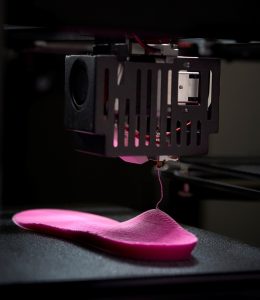
Shoe insoles can significantly reduce strain. Two FHNW schools are developing innovative materials and manufacturing processes. A new 3D-printing technology is transforming how custom shoe insoles are made. At orthopaedic footwear company Orthopodo Malgaroli, a printer rapidly builds a tailored insole from soft, multi-hardness filaments – ideal for a diabetes patient with reduced foot sensitivity. By precisely relieving pressure on vulnerable areas, the insole helps prevent unnoticed injuries and improves comfort. This innovation is the result of close collaboration between the FHNW School of Life Sciences, the FHNW School of Engineering and Environment , Orthopodo Malgaroli, and funding partners including ChallengeEU associated partner Hightech Zentrum Aargauand Innosuisse, the Swiss Innovation Agency. Until now, producing insoles with varying hardness required complex CNC milling, which was noisy, wasteful and labour-intensive. The FHNW team developed new print heads and an automated tool-changing system that enables the printer to combine different material hardnesses in a single insole. At the FHNW School of Engineering and Environment, researchers created sustainable, medically safe filaments made from castor beans: antibacterial, skin-friendly and recyclable. “The shift to automated insole design and 3D printing is a major paradigm change,” says Daniel Seiler, Head of the Medical Additive Manufacturing Lab. These precisely manufactured insoles aren’t just for people with diabetes. Under the brand moxxis, custom 3D-printed insoles can now be produced within an hour even in sports shops preventive, making personalised foot support accessible to everyone. Link: Auf diese Technik kann man stehen | FHNW

INCLUDO: How inclusive is Artificial Intelligence?

INCLUDO focuses on a highly topical issue: Artificial Intelligence and Diversity. Artificial Intelligence (AI) promises new opportunities – such as barrier-free tools or personalized learning offers. At the same time, cases of bias, discrimination, and stereotyping continue to emerge. How inclusive is AI, and what do we as users need to be aware of? We will explore these questions in an interactive workshop. Following an expert input from AI specialist Sonja Angehrn, we will jointly test various AI tools for their diversity competence and compare the results. What you’ll take away: Understanding: How does AI work – and where are its limitations? Competence: How can AI results be critically evaluated? Practice: Hands-on prompting – testing how AI responds to diversity topics Inspiration: Tools and strategies to make AI use more inclusive Date/Location: Tuesday, December 9, 2025, 4.30-6.30 PM, FHNW Campus Muttenz (Aula) or online via MS Teams (Link will be sent after registration) Program: 4:30 PM Welcome & Introduction to the topic 4:45 PM Expert input by Sonja Angehrn, Lecturer at ICAI – Interdisciplinary Center for Artificial Intelligence, OST 5:30 PM Group work: Testing AI tools 6:00 PM Discussion of results & take-home messages 6:30 PM Joint Apéro INCLUDO will be held in English and German. The event is part of the university alliance ChallengeEU.

Online Training on E-Accessibility

FHNW is organising an online exchange and training session on E-Accessibility, aimed at those interested in digital learning, communication and inclusion within the ChallengeEU Alliance (in particular within WP2, WP5 and WP6). Together with experts Andrea Gerber (FHNW) and Markus Böni (Access for All, participation requested), the event will address current challenges and good practices for making digital content accessible to all users. The session is designed to spark ideas, support reflection on institutional practices and connect participants engaged in E-Accessibility across the alliance. Programme outline: Kick-off Expert input: Andrea Gerber (FHNW) Expert input: Markus Böni (Access for All, participation requested) Breakout sessions: Highlights & Lowlights Key findings and discussion Wrap-up The event is open to participants from all ChallengeEU partner institutions and associated partners who are interested in E-Accessibility and inclusive digital practices. More information: leonie.wallisch@fhnw.ch

Design Meets Football: FHNW Students Create Jerseys for Swiss Champions

Photo: FC Basel In a remarkable collaboration between sport and design, four master’s students from the Basel Academy of Art and Design FHNW have co-designed the new jerseys for FC Basel 1893, one of Switzerland’s most iconic football clubs. Known for its passionate fan base and rich history, FC Basel recently celebrated a major comeback, winning both the national championship and the Swiss Cup. The jersey design project, led by fashion design lecturer Jacqueline Loekito, brought together students from the Masterstudio Fashion Design, Masterstudio Industrial Design and Masterstudio Scenography. Over 18 months, they worked closely with the club and its equipment supplier to create the official home and away kits for the 2025/26 season. The design theme, Converging Currents, draws inspiration from the Rhine River, which flows through Basel and symbolizes connection and movement. The home jersey features twisting blue and red stripes – FC Basel’s traditional colors – while the away jersey blends them into a shimmering purple, evoking the glittering surface of the river. “We wanted to create something that reflects both the club’s heritage and the energy of the city,” says scenography student Connor Muething. The students also explored the club’s archives, studying decades of style and material evolution. The result is a modern yet meaningful design, with details like outward-twisting stripes at the collarbone and lighter stitching for added contrast. Beyond aesthetics, sustainability played a key role: each jersey is made from 100% recycled PET polyester, with 13 plastic bottles reused per piece. Now, the jerseys are ready to hit the field and the streets. “We’re excited to see how fans respond,” says fashion design student Livia Simoni. “We hope they’ll wear them with pride, far beyond the stadium.”
ChallengeEU Strategy Board Meeting in Switzerland

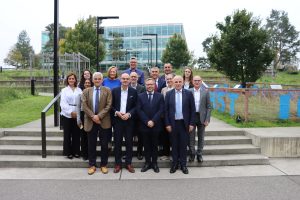
Strategy Board gathered at Fachhochschule Nordwestschweiz FHNW for two inspiring days (8–9 Oct) of exchange and strategic dialogue between rectors and student representatives. Participants also had the pleasure of touring the FHNW campus in Windisch. They were hosted by, among others, FHNW President Crispino Bergamaschi, with Arne Wahlen, Peter Flohr, Rico Travella, Guido McCombie, and Brandon Panos sharing insights into their respective schools: ChallengeEU has been accepted into the circle of ‘European University Alliances’ and will be funded by the European Commission from 2025 to 2028 as part of this flagship initiative of the European higher education strategy. As a Swiss partner, FHNW is funded by Movetia as part of the Swiss European Mobility Programme (SEMP).
ChallengeEU Meets with Partners at FHNW

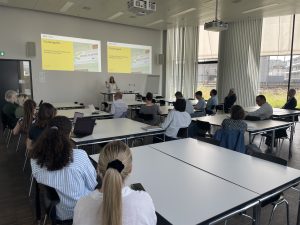
Strengthening regional partnerships is one of the key ways the ChallengeEU Alliance ensures that its work creates tangible impact in local communities across Europe. These partnerships bring the Alliance’s mission closer to reality by connecting higher education institutions with the people, institutions, and industries that shape their surrounding ecosystems. In June, this commitment took a meaningful step forward during a special meeting at Fachhochschule Nordwestschweiz (FHNW) in Switzerland. The ChallengeEU team, together with FHNW President Prof. Crispino Bergamaschi, had the pleasure of presenting the Alliance’s current initiatives to a group of associated partners from the Northwestern Switzerland region. The meeting sparked engaging discussions and laid the foundation for exciting future collaborations. Topics ranged from the evolving needs of students and early-career professionals, to major challenges and opportunities in digitalisation, robotics, artificial intelligence, and diversity. A particularly meaningful part of the exchange focused on the topic of neurodiversity and how schools and employers can better support individuals with diverse cognitive profiles. Initial ideas for joint projects and synergies are already emerging, and all participants shared a strong interest in shaping initiatives that are creative, sustainable, and truly future-oriented. This meeting clearly demonstrated the added value of close cooperation between universities and their regional environments — a core principle of the ChallengeEU Alliance. We are excited to continue these conversations and turn them into concrete, impactful action.